DON'T LET IT BE A BLACK AND A WHITE ONE

Ice Cube, before he became a comic prop in family vacation movies, understood a fundamental truth about race and law enforcement 30 years ago that still has not sunk in with a lot of Americans.

Ready? All of the issues with race and law enforcement apply regardless of the race of a particular officer. Cops use more force against black suspects.

online pharmacy buy amitriptyline online no prescription pharmacy

White cops. Black cops. Male cops. Female cops. Cops. That's the point – it's a systemic problem, not a "Few bad apples" problem.

And on the other hand, without a gun they can't get none
But don't let it be a black and a white one
Cause they'll slam ya down to the street top
Black police showing out for the white cop

Sure, it would be a good idea (for any number of reasons) for police departments to hire a diverse group of officers. But "We have black cops too" doesn't mean that issues of race and law enforcement go away. It's still there. If cops generally perceive that black male suspects are a threat, that can go as well for non-white cops as for white ones. Three of the cops who beat Freddie Gray to death, to cite just one example, were black. They didn't stand there and watch the three white cops beat him. They didn't say "Hey you know this seems to be an excessive amount of force." They participated. Whether they were "showing out for the white cops" or behaving how they would have behaved if all of the cops involved were black is conjecture. What isn't conjecture is that black cops, like white, Hispanic, Asian, left-handed, and Turkish-Romanian cops, were part of the problem.

online pharmacy buy symbicort online no prescription pharmacy

Because the problem is bigger than cops. The problem is with the system. We repeat the lie that it's just a few bad apples, one or two loose cannons here and there, because it transfers responsibility from the system to the individual. And when the problem is the individual…
buy doxycycline online buy doxycycline no prescription

oh well, what are you gonna do, right? See also: mass shootings.

Cities are racing to appoint black cops to top positions in troubled departments. Chicago recently jumped on the bandwagon, appointing an unknown, inexperienced (administratively) beat cop named Eddie Johnson as Superintendent in response to public uproar that has already taken down the Cook County State's Attorney in the recent Democratic primary. Look, it makes no sense to begrudge the city promoting a beat cop, a black cop, or a black beat cop to a position of authority.
buy flexeril online buy flexeril no prescription

It's probably not a bad idea. The problem is that when these appointments are made, it's not hard to picture everyone in the Mayor's office and Police HQ slapping their hands together and exclaiming, "Problem solved!"

It's not a solution. It is, at worst, window dressing and, at best, a red herring. The problem in Chicago is not that there weren't or aren't enough black cops in the upper ranks. The problem in Chicago is that the police department has proven itself totally rotten, corrupt, conspiratorial, and willing to go to any length to protect its own. Top to bottom. The whole thing. Maybe Eddie Johnson will be a good Super, maybe he'll be gone in six months. Who knows. The point is that appointing him, or anyone else, does not solve the problem. And these appointments of black cops to high ranking position at a time when police departments are reeling from being asked to answer for the massive numbers of unarmed black suspects they bring to the morgue feels a lot less like a legitimate effort to bring diversity to leadership positions and a lot more like a cynical PR ploy to allow the old, white, reactionary base on which urban politics still depends to say "We appointed a colored, what more do you want."

BEYOND DESCRIPTION

The "Anybody but Hillary" defense of voting for Trump is already bubbling to the surface. It's unsurprising, since it sounds much better than "I don't like brown people but I'm smart enough not to admit it." It will be popular among the usual suspects who were going to vote Republican no matter what despite protests about evaluating the candidates on their merits. You know. Old white people.

In the long run it isn't consequential because 2012 already proved that there aren't enough of them to win an election.

online pharmacy lexapro no prescription

The logic, or the implied logic, is pretty interesting though. Whenever I encounter someone who talks about what a nightmare the Bill Clinton years were, I really push them on specifics. Was it the rapid economic growth? The balanced budget? The lack of full-scale wars? Of course Bill wasn't personally responsible for everything positive that happened during his two terms.

online pharmacy azithromycin no prescription

I'm just trying to wrap my head around what exactly was so bad. It inevitably boils down to 1) He banged an intern, which is important because Reasons, and 2) He humiliated the country by using diplomacy with other nations rather than pulling his dick out and waving it around screaming AMERICA #1 SUCK IT. Nothing rankles these people like a perceived lack of Ass-Kickin' toughness.

Policy-wise, about the worst thing old white people could expect during a Hillary Clinton presidency is for personal income tax levels to stay where they are (Let's briefly ignore the fact that in the name of the god Centrism, she'll probably sign a few gratuitous tax cuts just because). It is very difficult to wrap my head around a level of narcissism and a provincialism of worldview that could leave someone unable to conceive of anything worse than…not getting more tax cuts. But probably getting more tax cuts anyway.

Really? You can't think of anything worse?
buy singulair online buy singulair no prescription

You'll vote for literally anyone to avoid voting for someone with a proven track record of blowing up small countries (Which Old White People like!) and a level of fiscal liberalism about as powerful as Ronald Reagan's?
buy clomid online buy clomid no prescription

I mean, I can think of much worse things than that. War. Famine. Genocide. Destruction of the planet. The breakdown of civil order. Worsening economic and social inequality. The loss of personal freedoms in the name of religious dogma. Paying full sticker price for a Dodge Charger. Really, any remotely imaginative person should be able to think of hundreds of worse things than four bland, middlebrow years of Hillary Clinton protecting the status quo.

But not your parents. For them, nothing could equal that horror. For some reason. Look, it can't be explained. Just because. Go clean your room.

HOLIDAYS IN THE SUN

Donald Trump and his supporters are absolutely right about one thing when it comes to immigration.

Hold on. I'm going somewhere with this.

It is correct to say that in the United States, and to an even greater extent in Europe, existing laws on immigration are poorly enforced. What they don't understand, though, is that immigration laws have never been enforced strictly, here or elsewhere.
buy prednisone online buy prednisone no prescription

It is today and always has been a matter of political expediency to write strict immigration laws and a matter of economic necessity to enforce them with great laxity.

During the first great American hysteria over immigration in the mid-19th Century – the target of opportunity was the Irish, although over the remainder of the century it evolved to Italians, Poles, Slavs, and all nationalities of Eastern European Jews – restrictive immigration laws were passed not infrequently in Congress. And anti-immigration elites (and labor leaders like Samuel Gompers, who feared the dilution of wages) were regularly incensed to see how poorly those laws were enforced. Weak enforcement was, and is, no accident. During the Industrial Revolution, massive amounts of raw physical labor were needed to mine the coal, pour the steel, work the powerhouses, and many other varieties of hard, physically demanding, often dehumanizing work. Since few Americans could be found willing to work themselves to death for wages that ranged from mediocre to scandalous, the captains of industry of the day understood that they needed another source of labor.
online pharmacy flexeril best drugstore for you

Eastern Europeans in particular – not a small of stature people by nature – were ideal candidates. And that's why I live in the United States right now, because sometime around 1910 a guy who looks kinda like me was willing to do literally any job for a chance to live here.

The country admitted millions of immigrants who should have been, by the strict letter of the laws, sent back to Europe. But big business has a tendency to get what it wants in this country, and they wanted bodies.
online pharmacy symbicort best drugstore for you

Waving those bodies through the gates without too much regard for immigration laws first made our economy great, then made our society great.

Things are no different today excepting the direction on the map from which the immigrants are arriving. Business needs low cost labor for manual and other unskilled work. Political populism demands strict immigration laws to keep the nativist and xenophobic tendencies in the electorate satisfied. Everybody with power gets what they want – politicians get votes, industry gets labor.
buy fildena online buy fildena no prescription

In a rare example of wants coinciding, the immigrants get what they want as well. As best anyone who has studied the matter now or historically can determine, what they want is little more than a chance to work like dogs for very little money in return for living here.

So, Trump is not wrong when he says immigration laws are enforced haphazardly. What he is too thick or too politically savvy to mention, though, is that people like Donald Trump are the exact reason that this situation exists. Capital wants labor, and American teenagers are not going to pick fruit in 85 degree heat for 14 hours per day with little complaint. If immigration laws were enforced at the level of the employer – imposing severe penalties for any workplace found employing undocumented immigrants – the problem would disappear. Of course that option is not on the table, because everyone in a position to affect these matters understands how crucial that low-wage labor is to our economy. Those guys stand in the Home Depot parking lot every morning at sunrise because someone is going to give them money in exchange for work, not because they enjoy the view.

The incentives are today what they have always been: win votes with rhetoric and laws, keep the cheap labor coming – and the money flowing – with indifferent enforcement. If our economic oligarchs didn't want and need immigrant labor, the wall would long since have been built.

WORD CANNON

I put a lot of effort into plowing through the transcript of Donald Trump's open ended interview with the editors of the Washington Post, and then more into trying to think of what to make of it. Despite the fact that it will be unpleasant, please do try to read it. You have to see it to believe it.

It's…it's nothing. It's like a cannon that fires random batches of words at people.

A representative passage:

HIATT: But just – given the Supreme Court rulings on libel — Sullivan v. New York Times — how would you change the law?

TRUMP: I would just loosen them up.

RUTH MARCUS: What does that mean?

[Crosstalk]

TRUMP: I’d have to get my lawyers in to tell you, but I would loosen them up. I would loosen them up. If The Washington Post writes badly about me – and they do, they don’t write good – I mean, I don’t think I get – I read some of the stories coming up here, and I said to my staff, I said, “Why are we even wasting our time? The hatred is so enormous.” I don’t know why. I mean, I do a good job. I have thousands of employees. I work hard.

I’m not looking for bad for our country.

online pharmacy https://royalcitydrugs.com/zydena.html no prescription

I’m a very rational person, I’m a very sane person. I’m not looking for bad. But I read articles by you, and others. And, you know, we’ve never – we don’t know each other, and the level of hatred is so incredible, I actually said, “Why am I – why am I doing this?

Why am I even here?” And I don’t expect anything to happen–

"What would you do?"

"Something."

"What's something?"

"I don't know, I'll have to ask someone else."

About a third of the country is really excited at the prospect of this person getting in the White House.

OK, one more excerpt, the telling one:

But—and honestly, you know part of—I always say we have to be unpredictable. We’re totally predictable. And predictable is bad. Sitting at a meeting like this and explaining my views and if I do become president, I have these views that are down for the other side to look at, you know. I hate being so open.

So we should have a mentally unstable egomaniac – the Joker, in essence – running the military and the world's largest nuclear arsenal. You gotta keep 'em guessing! Be random and unpredictable so they never know what we might bomb the shit out of next! Who's "they"? Ah, it doesn't matter. We are best served by the rest of the world thinking we are lunatics, like North Korea.

I don't even know what to say anymore.

Read the transcript and if any part of you is not deeply alarmed by it, go to hell. This is like the Battlefield: Earth of presidential candidates – if you don't understand immediately and on a fundamental level why it's terrible, I'm not going to be able to explain it to you. Just go away to one of the places in this country set aside for garbage human beings. Try Mississippi.

CAN'T FIND THE WORDS TO SAY

Most of the rants you will encounter about The Kids These Days focus on their supposed sense of entitlement, their sensitivity, or their shortening attention spans.
https://westsomervilledental.com/wp-content/uploads/2022/11/jpg/desyrel.html

Over the past five to eight years I've noticed consistently something much more worrisome.

Having taught an Intro to American Government course at least three times per academic year, and sometimes four, for some time now I know which parts of the course students will get easily, which ones will take a little more effort, and where some of them will fall off the bandwagon. Increasingly I've come to realize from blank stares that there is a basic problem in some cases with understanding the language I use in class. I don't mean that I have a dense accent or that I mumble; I mean over time I've realized that entire classes of students will be ignorant of the definitions of fairly basic terms.
buy xenical online www.lifefoodstorage.store/wp-content/languages/new/prescription/xenical.html no prescription

For example, I have had entire classes – and it's not just that they don't want to speak in class, since I call on them and try to make them come up with an answer – unable to define the following:

– Deference
– Meritocracy
– Contentious
– Bicameral
– Substantive
– Precipitate (as in to cause an event)

Of those, only bicameral could be considered a Term of Art unique to the subject. The others are just..words. They're words that I use without conscious thought and the idea of any adult high school graduate being unable to make sense of them doesn't occur to me.
https://westsomervilledental.com/wp-content/uploads/2022/11/jpg/antabuse.html

And without getting into specifics, this is merely a sample of words I have to stop and define routinely and for which entire classes are unable to divine the meaning. On an individual basis I get asked to define words on an exam or in a lecture all the time, some of which…I mean, if a student does not know I'm glad that he or she asks to have it defined, but…I've had to stifle the "Are you serious?
buy ivermectin online www.lifefoodstorage.store/wp-content/languages/new/prescription/ivermectin.html no prescription

" reaction a handful of times. You would too, trust me.

The issue is, I have no desire to talk down to college students, treat them like kids, or dumb things down to reflect lowered expectations. So part of the problem might be that I simply talk to them like adults who are in college – at a good school; not Harvard, but certainly no worse than Good – and that assumes that they came to college with a basic level of knowledge from high school. Given what goes on in high schools, that may be a flawed assumption. On the other hand, part of me looks at that list and thinks, c'mon…

So add to the litany of problems with The Kids a shrinking vocabulary. Despite the anecdotal nature of this post, the data reinforce my conclusion – vocabularies are getting worse with time. It may not be rocket science; students' attention spans shrink, the amount that they read decreases (unless you count Snapchat, YouTube videos, and memes), and they simply aren't exposed to many attempts to communicate with them on an adult level in writing. And that's where you learn words. You learn them by reading, and reading things that aren't crap. We simply don't do that much anymore as a society. It shows.

GO YOUR OWN WAY

The Republicans are getting more frantic about the prospect of Trump winning their nomination. Various semi-secret "meetings" are being held to consider increasingly desperate-sounding options – a Cruz-Kasich "unity ticket", convention shenanigans, rule changes, and so on – and that hardly can be interpreted as a positive omen. When a group of people priding itself on refusing to change finally gets around to admitting that there is a problem, it's likely already too late.
buy vibramycin online buy vibramycin no prescription

But what if they do succeed in coming up with a means of denying Trump the nomination? Aside from those riots he has promised, the assumption is that Trump would continue as an Independent candidate. If he's as rich as he claims to be, certainly he could afford to do so (especially given that he doesn't have to pay for media exposure).

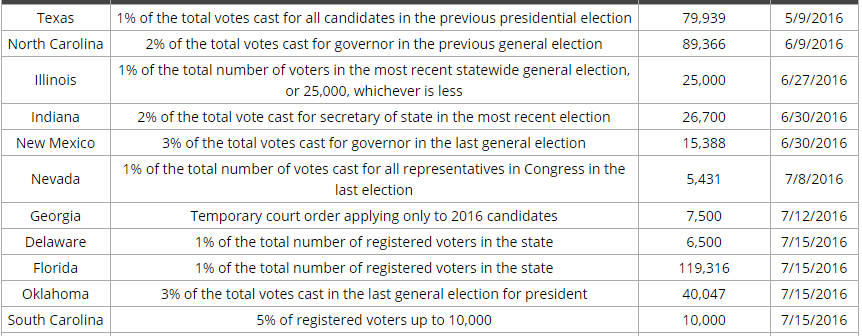
The problem with the Trump-as-Independent (or some GOP savior running as Independent after Trump secures the nomination) is the fundamental issue of ballot access. Every state and territory has its own rules and deadlines for who can appear on the November election ballot. The Republican Convention is scheduled for July 18-21, by which point 11 states' deadlines will have passed.

Deadlines

Go ahead and try to conceive of a scenario in which a Republican or Independent Trump wins the election without being on the ballot in Texas, Florida, and North Carolina. I'll wait.

That would leave two remaining options. The first is to run what would be at least partially a write-in campaign.
https://westsomervilledental.com/wp-content/uploads/2022/11/jpg/temovate.html

Texas, with its early May deadline, at the very least would end up requiring write-ins. The second would be to use an existing third/minor party that has already secured ballot access.
buy flagyl online buy flagyl no prescription

Even this Hail Mary strategy is problematic, though. The Libertarian Party leads current U.S. third parties with ballot access in 34 states. That's less than 2/3 of the states. The Green Party isn't going to help (and is in only about 20 states). The wingnut Constitution Party would be a logical home, but they're barely in a dozen states (they claim 15, although other sources list fewer).

The upshot is that Trump as an Independent, assuming that his quest for the GOP nomination is thwarted (if at all) at the convention in mid-July, would be running solely as a spoiler. He wouldn't even be on every state's ballot, and the idea that he's going to win an Electoral College majority with a mishmash of write-in and Independent votes borders on silly.
https://westsomervilledental.com/wp-content/uploads/2022/11/jpg/ivermectin.html

In any scenario in which Trump and another Republican are both running it's inevitable that they will split the right-wing vote and lead to a Democratic blowout in the Electoral College. If you have wondered what the Republican Party's strength would be without the Tea Party, this will provide the answer.

I can't wait.

BEEN THERE

I really like Bernie Sanders.

Beyond liking him I have great respect for how well he has done in this election. On paper we would not expect the campaign of a 74 year old Jewish Vermonter who has been in Congress for 25 years to get a presidential campaign off the ground let alone have some success. He has energized left-wing voters and raised issues that need raising, requiring the other candidates (especially in his own party) to take those issues seriously. His presence has been nothing but a positive.
online pharmacy cipro best drugstore for you

Long-time readers know my feelings about Hillary Clinton. I have no opinion about her as a person but border on despising her as a politician. I don't care to sift through all the Election 2008 posts to prove that to you if you're a new reader, but now in 2016 I feel no differently about her.
buy symbicort online buy symbicort no prescription

She's a weathervane, an neoliberal on economics, and, like her husband, more than willing to get in line with the interests of neocon foreign policy hawks and law enforcement when she feels it will benefit her. She has the "right" position on a lot of issues too, but the amount of baggage it comes with is substantial.

All that said, at this point it appears very unlikely, although not impossible, that Bernie Sanders is going to win the Democratic nomination. Before you get in a tizzy about crooked rules and superdelegates, be aware that Clinton leads Sanders by a considerable margin in pledged delegates. That is to say, if there were no superdelegates she'd still be winning. We saw in 2008 that superdelegates are a bandwagon crowd when both candidates are viable. They backed Hillary until she started losing; when Obama took the lead, they backed him. Were Sanders to take an Obama-like lead this year, I firmly believe they would jump ship on Hillary again. They're in it to pick a winner, not to impose their will on the Democratic Party or pay back favors to the Clinton family.

Upcoming primaries on the West Coast will feature states in which Sanders is likely to be strong. Needing nearly 60% of the remaining pledged delegates to catch Clinton in that category makes his victory unlikely at best, though. He doesn't just have to start winning every contest, he needs to start winning every contest handily. It's possible. But it's not probable.

As that becomes increasingly clear, here comes the flood of "If _____ doesn't win the nomination, X% of (Democrats/Republicans) will not vote for (actual nomination winner)" stories. You've already seen them. We saw them in 2008, when Clinton supporters allegedly were going to vote for McCain or not at all rather than Obama. We saw it in 2012 with every GOP contender's fans and Mitt Romney.
buy azithromycin online buy azithromycin no prescription

And it's all bullshit. It's a false narrative. People say, mid-Spring, that they're so mad they won't vote for Clinton if Sanders loses. They'll throw tantrums. Then they'll get over it, and by November they'll show up and vote for her. They won't feel good about it. But that doesn't matter, practically. Everyone who has been through more than one election cycle realizes that this process is not one that feels good or that gives us our ideal preferences. It's one that gives us two choices and we pick the one who isn't a complete lunatic. It's a bad system; at present, however, it is our system. I don't like it. Nobody cares whether I like it.

If life was about getting what we wanted and having great choices, we wouldn't be getting out of bed at sunrise to go to work right now. I don't like Hillary Clinton, nor will I feel particularly excited about voting for her, but when the other candidate is running with the support of actual white supremacists you just kind of suck it up and pick the less-bad one. The amount of white privilege that goes into a statement like "I'd rather stand on principle and end up with Trump than blah blah blah" is too obvious to dwell on here. If you lack the self-awareness to understand why, ask someone who isn't white and when they're done silently loathing you maybe they'll explain it and help you out.

In the end – of the election process, that is – there are some people who will waste their vote on a third party candidate who isn't going to win or skip voting altogether. That's their right, obviously. But despite Republican wishful thinking claiming otherwise, the vast majority will get over it and vote for Clinton.
online pharmacy ventolin best drugstore for you

Especially when Sanders, as every major party candidate in memory has done, endorses the frontrunner and asks his supporters to support her moving forward.

I understand how they feel, the Sanders people. In 2000, my second presidential election, I was a staunch Naderite. I know all the arguments because I've made all the arguments, about principle and corporate Democrats and how the system won't change if we continue to reward it. That was 16 years ago. The current Republican candidate(s) make George W. Bush look like FDR. The stakes are high, and this is not a joke. We have to live with what happens here, whether it is our ideal outcome, an outcome we don't like but can live with, or one that puts some of our friends, neighbors, and colleagues at risk of having to hope for the best under a candidate openly supported by and supportive of neo-Nazis.

In reality it probably won't matter; Trump is going to get blown out regardless of what you or I choose to do as individuals. But on the off chance that you live in one of the handful of places where your choice might actually matter, think hard over the next few months about how much your Principle is really worth to you. Pay close attention to Trump/Cruz and ask yourself if you can't summon the strength to vote for a lame, DLC corporatist Democrat to decrease the chance that those men won't soon have control of the White House with a pliant Republican House majority.

Choose wisely.

IS THERE A DOCTOR ON THE PLANE

It's hard to have anything other than mixed feelings about the success of protesters in Chicago and St. Louis in shutting down Trump rallies. In one column we have all the usual arguments about how violence is never the answer, Trump has a right to express himself, etc and etc. In the other, it's refreshing to see that some people correctly perceive that this is something much different than the ordinary Republican presidential campaign.

buy flexeril online www.tvaxbiomedical.com/css/src/css/flexeril.html no prescription

This is the coming together of the worst that American society has to offer, of people who think violence literally is the answer to everything and whose conception of ideology and beliefs is to keep current a lengthy list of things they hate.

To watch these protests escalate and grow, though, is to have the increasingly uneasy feeling that none of this will end well, and I don't mean it will end with Trump getting elected. Call me alarmist, but it feels like only a matter of time until someone gets shot.

I have a student who announced in class his intention to go to the anti-Trump rally in Chicago. I told him to be careful, and although the line produced a mild giggle from the class I very much meant it. Trump supporters are people who think George Zimmerman is a hero and who long to someday get their own chance to shoot a black person. How many violent, stupid, blind-with-rage gun enthusiasts can gather in one place to be egged on by their idiot king before a protester shoves one of them who immediately thinks, "This is the big moment I've been waiting for"?

Remember, these are people who believe with all their might that carrying a concealed handgun makes them safe, and that they possess the judgment to know when and how to use it appropriately. These are wannabe vigilantes, every one of them, waiting for an opportunity to make their own Rambo fantasies a reality. When people interrupt Trump during rallies he has the extremely disconcerting habit, as we would expect of someone with a brain the size of a peanut and an aversion to thinking before he says anything, of yelling out nonspecific commands like "Get 'em out of here!" to no one in particular, which makes every individual member of his audience think, "Time for me to be the hero!" in a roomful of people who consider punching a teenage black girl a heroic act.

buy udenafil online www.tvaxbiomedical.com/css/src/css/udenafil.html no prescription

A responsible person might tell the crowd to relax because security is going to handle the situation, or direct any comments to the police present. This is why flight attendants get on the intercom when a passenger is sick and say "Excuse me, is there a doctor on this flight?

buy fildena online www.tvaxbiomedical.com/css/src/css/fildena.html no prescription

" instead of "Oh shit, somebody help this guy!"

None of this is surprising as the culmination of eight long years of "Take America back" rhetoric, the answer to the question "From whom?" remaining unspoken but easy enough to derive by implication – from the blacks, the Latinos, the homos, the bitches, the Jews, the librul media, the unions (???), the ivory tower academics, and everyone and anyone else who aspires to be something other than a meatheaded, bigoted loser pretending that the reason they never accomplished anything with their lives is that racial and cultural Others usurped what was rightfully theirs.
online pharmacy trazodone best drugstore for you

I'm hardly the first person to suggest that this is not going to end well, but I'll add myself to the chorus nonetheless.
online pharmacy amoxicillin best drugstore for you

If you thought Obama derangement was bad, wait until you see the meltdown these people have when Trump gets blown out in November. We'll be living among millions of vigilantes forced to endure yet another humiliation at the hands of people smarter than them, staring at their guns and wondering what else they can do to Take Their Country Back.

RADICAL SOLUTION

As much as I might like it to be the case, being a political scientist does not make me 100% informed about everything that can happen in American politics. We all have areas of expertise and beyond that the depth of what we know is not necessarily greater than any interested non-academic. Deep congressional procedure, for example, is a mystery to me. If you ask me about the Byrd Rule and the steps necessary to consider an omnibus bill under reconciliation. I have people for that, and without exception they can be taken out in public only infrequently and only at great risk.

That preemptive mea culpa is to admit that party nominating procedures are not something about which I have universal, all-encompassing knowledge. However, I've taught and worked with the topic enough to be comfortable with it. So I'm going to attempt to explain why the GOP is going to have a very, very difficult time setting up a "brokered convention" to stop Trump.

Brokered conventions are to politics what surprise witnesses are to the legal process – they're largely a narrative device used to create interesting scenarios, not a thing that actually happens in real life. They make good water cooler talk but the parties both have rules and procedures in place specifically to preclude them.

I'll keep this as basic as possible. Candidates compete in primaries, caucuses, and conventions in each state (and territories, oddly enough) to win delegates. Delegates are awarded on either a winner-take-all or a proportional basis. The early contests – the ones completed so far – must by Republican rules be proportional. The Democrats do it differently, but let's disregard that for now. Later GOP contests are mostly winner-take-all. The GOP used to do all W-T-A contests but changed recently when they realized that one candidate who did well for the first two weeks of contests would essentially wrap up the nomination. So this stretches the process out and generates more competition, because candidates who do not win the state still can win delegates under proportional rules.

Delegates are either committed (Republicans tellingly prefer the term "bound") or uncommitted ("unbound"). Committed delegates must vote on the first ballot at the national convention for the candidate that won said delegate in a primary. Uncommitted delegates can vote for whichever candidate they want. Some states award only committed delegates, and some states award only uncommitted. It's a very confusing system and all fifty states have unique rules. When a candidate wins committed delegates and then drops out of the race, those delegates become uncommitted.

What is not complicated is this: The GOP awards the nomination to whichever candidate gets a simple majority of available delegates. 50% + 1 of the current delegates is 1,237. Trump currently leads with 384 to Cruz's 300. The proportional system has treated Ted Cruz well, as you can see. Despite winning only four contests so far he is not terribly far behind Trump. If any candidate gets to 1,237 committed delegates, the race is essentially over.

There are two relevant internal rules in the GOP that must be understood here. One is a requirement that no candidate can be nominated who did not win a majority of delegates in at least eight states. That is crucial here. They can't nominate Mitt Romney at the convention no matter what. Nor, as things currently stand, could they nominate Cruz (four wins) or Rubio (one win) or anyone else (zero wins). The second important rule is that the Party can alter its own rules at the national convention without waiting until the next before any changes take effect.

So for a "brokered convention" one of two things must happen. First, the non-Trump candidates could win enough delegates to prevent Trump from reaching 1,237. If no candidate entered the convention with a majority, the first ballot (remember the committed rule) would be unlikely to produce a victor and then all bets would be off. Second, they could change any and all of the rules mentioned here, essentially blowing the whole thing up in a sort of anti-Trump Thermopylae; a last ditch, scorched Earth play. Cut off the limb and suffer in the short term to save the brand in the long term. And no, Trump could not mount an independent campaign at that point because in almost every state the deadline to get on the November ballot will have passed.

In short, to have a nominee other than Trump if and when he crosses 1,237 delegates would require the GOP to change its rules to disregard the entire primary process and let party insiders hand-pick a candidate. You can imagine how well that would go over with Trump supporters and Republicans in general. Then again, they might judge that to be worth it compared to letting Trump not only go down in flames but also to take god knows how many down-ballot candidates with him.

Finally, June 7 is likely to be a significant date, with California's 172-delegate, winner-take-all primary taking place. It's the last date for primaries and caucuses and if Trump has not secured 1,237 delegates already by then he will at least be in striking distance so that California would put him over the top.

Off the cuff it seems unlikely that the Republican Party would do anything as drastic as changing its rules at the convention to render moot everything that has happened in the nomination process to that point. It all depends on how effective the powers that be inside the party are at convincing themselves that Trump won't be so bad. The other issue is that the candidate best situated as a Trump alternative may be even more strongly loathed within the party.

Good. Times.

A VERY STUPID ARGUMENT GETS THE FJM TREATMENT

Rarely am I moved to revive the FJM Treatment these days, as it tends to be very labor-intensive to write and it's not often that I have the time. But when Mike Konczal – Those of you who have been around forever remember him, and those who haven't probably know his current work – shared this article with the baiting tagline, "Algebra II Has To Go", I felt the urge stirring inside me. Understand two things: One is that I realize I am falling for Outrage Bait here; sites like Slate push this stuff purporting to be "edgy" mostly in the hopes of getting people to share it socially and vent about how dumb it is. The second is that Mike approached this from the perspective of someone who has taken a lot of very high level math in his academic life and no doubt accurately points out that much of it has never been useful beyond college.

The problem is that this article isn't about high level math. It's about algebra, and its author Dana Goldstein has fallen hook, line, and sinker for the arguments of one person with an agenda to sell books about "curriculum reform" that only excite administrators looking to boost retention by identifying and then justifying the elimination of whatever courses are too difficult for students to pass. As a faculty member, I see this very differently because the motives are very transparent to me. I read a noble proposition like "What's wrong with improving the curriculum to include more useful math?" as a stalking horse that quickly ends up pressed into service of the least noble motives. Are you ready? It has been a while, but hopefully you'll agree that it's time. Some of this is excised for length and irrelevance.

In his new book The Math Myth: And Other STEM Delusions, political scientist Andrew Hacker proposes replacing algebra II and calculus in the high school and college curriculum with a practical course in statistics for citizenship (more on that later). Only mathematicians and some engineers actually use advanced math in their day-to-day work, Hacker argues — even the doctors, accountants, and coders of the future shouldn’t have to master abstract math that they’ll never need.

*RECORD SCRATCH SOUND*

Algebra II is "advanced math"? Nobody needs to know Algebra unless they're designing a rocket engine or mapping the human genome? Isn't a sequence in Algebra, like, a rather basic component of math education? Gee I'd hate to think the authors are using an argument – a valid argument – against taking advanced calculus as a red herring here.

I showed the book to my husband, Andrei, a computer programmer who loved math in school. He scrunched up his face. “People don’t use Shakespeare in their jobs, but it’s still important for them to read it,” he said.

I like Andrei. Andrei seems to understand the educational system and its purpose.

“It’s not the same,” I told him. “Reading fiction builds empathy.”

“Math helps us understand the world around us!” Andrei replied. “Like how derivatives demonstrate change over time.” He smiled, and I could tell that for him, it was all clear and beautiful.

But I had no idea what he was talking about. In high school, I found math so indecipherable that I would sometimes cry over my homework. I don’t think I ever understood what a derivative signified 15 years ago, when I was struggling my way to a low B in calculus—a class I was convinced I had to take to pad my college applications.

Oh good. I'm glad we're establishing from the outset that the basis of this article is "I don't get it, so it's not necessary."

*EXAGGERATED FOREHEAD WIPE*

So Hacker’s book is deeply comforting. I’m not alone, it tells me—lots of smart people hate math. The reason I hated math, was mediocre at it, and still managed to earn a bachelor’s degree was because I had upper-middle-class parents who paid for tutoring and eventually enrolled me in a college that doesn’t require math credits in order to graduate.

This is impressive self-awareness. The author recognizes that she finds this argument appealing not because it has merit but because she hates math and thought math was hard. Glad we're all on the same page now.

For low-income students, math is often an impenetrable barrier to academic success. Algebra II, which includes polynomials and logarithms, and is required by the new Common Core curriculum standards used by 47 states and territories, drives dropouts at both the high school and college levels. The situation is most dire at public colleges, which are the most likely to require abstract algebra as a precondition for a degree in every field, including art and theater.

*CAR CAREENS OVER CLIFF*

How many colleges require anything beyond the most basic type of two-course math sequence, one or both of which can be satisfied by having taken "college level" math courses of dubious rigidity in high school? I guess Slate doesn't make its writers look up numbers on these things. My experience has been that what college level math is required is often required with some kind of massive loophole such as the ability to fulfill the obligation with specially created, easy to pass "Math for Poets" type classes designed to keep the tuition dollars students enrolled.

“We are really destroying a tremendous amount of talent—people who could be talented in sports writing or being an emergency medical technician, but can’t even get a community college degree,” Hacker told me in an interview. “I regard this math requirement as highly irrational.”

Community college math classes are too difficult? Hmm. That would point to getting very little math in high school, not too much, Mr. Iconoclast. This literally differs not one bit from arguing that someone would make a great EMT if only they didn't have to take some stupid class they can't pass about Shakespeare or psychology or hey this is fun you could put the name of any course in here and the appropriately-surnamed Hacker's argument works!

Unlike most professors who publicly opine about the education system, Hacker, though an eminent scholar, teaches at a low-prestige institution, Queens College, part of the City University of New York system. Most CUNY students come from low-income families, and a 2009 faculty report found that 57 percent fail the system’s required algebra course. A subsequent study showed that when students were allowed to take a statistics class instead, only 44 percent failed.

"When these students had to take a basic math course, slightly over half failed. When we let them take another course that for all anyone knows was designed to be easier to pass so we could keep our retention rates up…slightly under half failed." Sounds like Hacker is an "eminent scholar" in some field that isn't statistics. Oh wait, he's a political scientist. So he should be well aware of how stupid this argument is. And he has taught at the university level for quite some time, so he also knows how deceptive it is. And that he's basically just arguing "We should let them take statistics because apparently it's easier for them to pass," which is the worst possible argument for why they should take statistics instead of math.

Math in this case, just to remind you, is algebra.

Such findings inspired Hacker, in 2013, to create a curriculum to test the ideas he presents in The Math Myth. For two years, he taught what is essentially a course in civic numeracy. Hacker asked students to investigate the gerrymandering of Pennsylvania congressional districts by calculating the number of actual votes Democrats and Republicans received in 2012. The students discovered that it took an average of 181,474 votes to win a Republican seat, but 271,970 votes to win a Democratic seat. In another lesson, Hacker distributed two Schedule C forms, which businesses use to declare their tax-deductible expenses, and asked students to figure out which form was fabricated. Then he introduced Benford’s Law, which holds that in any set of real-world numbers, ones, twos, and threes are more frequent initial digits than fours, fives, sixes, sevens, eights, and nines. By applying this rule, the students could identify the fake Schedule C. (The IRS uses the same technique.)

In his 19-person numeracy seminar, the lowest grade was a C, Hacker says.

Wow. Where to start. OK, so this "civic numeracy" course, designed by Hacker himself and which based on the examples he chose to give involves nothing beyond addition, subtraction, division, and the ability to read English and numbers, produced 19 passing grades when Andrew Hacker taught said class (and awarded the grades, so you know it was super objective because he certainly had no motivation to prove his point, right?). Does anyone know if 19 is a sufficient sample size? I guess they didn't cover "sample size" in "civic numeracy."

Look, I'll be the first one to agree that a class where students learn how to read and interpret statistics is valuable. I teach this very material in a Political Science Research Methods course. It's important. And it is in no way an argument against the value of taking actual math. The sole motivation behind requiring it instead of math is that too many students now are failing math.

Or are they? Who knows, neither the author of this article nor apparently the shittiest social scientist on Earth bothered telling us if students are failing math more regularly today than in the past. That would be important to establish, right? Or else he/she have no argument, right?

Hacker’s previous book, Higher Education? How Universities Are Wasting Our Money and Failing Our Kids, took a dim view of the tenured professoriate, and he extends that perspective in The Math Myth. Math professors, consumed by their esoteric, super-specialized research, simply don’t care very much about the typical undergraduate, Hacker contends.

Ahh, OK. Finally we've established that Hacker makes his living publishing (presumably not without compensation) books pissing on academia. I know this type well. Bet he's real popular with his colleagues between his open minded approach to curriculum and his outstanding argumentation skills.

Math professors, consumed by their esoteric, super-specialized research, simply don’t care very much about the typical undergraduate, Hacker contends. At universities with graduate programs, tenure-track faculty members teach only 10 percent of introductory math classes. At undergraduate colleges, tenure-track professors handle 42 percent of introductory classes. Graduate students and adjuncts shoulder the vast majority of the load, and they aren’t inspiring many students to continue their math education. In 2013, only 1 percent of all bachelor’s degrees awarded were in math.

None of this is remotely relevant to the value of making students take basic algebra. Not even a little. These numbers are here to distract you. I thought we were making a "should" argument about the value of stats-as-math-alternative? Now we've progressed to simply grousing about academia.

“In a way, math departments throughout the country don’t worry,” Hacker says. “They have big budgets because their classes are required, so they keep on going.”

This is the least true thing anyone has written today, and today was the day after Donald Trump all but secured the GOP nomination. What's actually happening, not that Hacker would bother to do any research here, is that math departments are piling more courses on tenured or tenure track faculty (not necessarily introductory courses – note the key adjective he uses) to save money, and also hiring more adjuncts to teach the less demanding courses to save money.

What an excellent example of how to deceive with numbers. Is this in the "civic numeracy" book?

After Hacker previewed the ideas in The Math Myth in a 2012 New York Times op-ed, the Internet lit up with responses accusing him of anti-intellectualism. At book length, it’s harder to dismiss his ideas.

I'm dubious.

He has a deep respect for what he calls the “truth and beauty” of math; his discussion of the discovery and immutability of pi taught me more about the meaning of 3.14 than any class I’ve ever taken.

I bet he does, and I'm sure it did. That's not saying much, per the author's opening comments.

As a longtime education reporter, I know that American teachers, especially those in the elementary grades, have taken few math courses themselves, and often actively dislike the subject. Maybe I would have found abstract math more enjoyable if my teachers had been able to explain it better, perhaps by connecting it somehow to the real world. And if that happened in every school, maybe lots more American kids, even low-income ones, would be able to make the leap from arithmetic to the conceptual mathematics of algebra II and beyond.

Well, a decent social scientist could tell you that since K-12 teachers are so regularly and viciously shit on, not to mention underpaid and regularly threatened by state legislatures with further reductions in benefits and pay, nobody really wants to major in Education. So Education gets the students – Sorry, but if we're going to generalize here, this is accurate… – who can't succeed in any other major. And it gives them a 4.0 in courses specifically designed to be passed by students who are not very academically capable.

Search your heart. You know it to be true.

Of course, if math teachers are to help students understand how abstract concepts (EDIT: Examples omitted) function in the real world, they will have to understand those abstractions themselves. So it’s not reassuring that American teachers are a product of the same sub-par math education system they work in, or that we hire 100,000 to 200,000 new teachers each year at a time when less than 20,000 people are majoring in math annually.

OK so, to recap: Math is too hard because most K-12 students get a bad math education because teachers don't take much math in college, so let's require even less math in college.

Goddamn brilliance.

Could better teachers help more students pass algebra II? Given high student debt, low teacher pay, and the historically low status of the American teaching profession, it would be a tough road. In the meantime, it’s probably a good idea to give students multiple math pathways toward high school and college graduation—some less challenging than others. If we don’t, we’ll be punishing kids for the failures of an entire system.

Wait, what? So this isn't about offering a better alternative at all, then. It's explicitly about offering something easier. Easier and Better are very different, just FYI. "Poor kids have a disadvantage, so let's teach them less and lower the bar for them because the system failed them." Because the system failed them, obviously the system must fail for them. Makes sense.

Make no mistake about this whole trainwreck of an argument, folks: This is about retention rates and tuition dollars. The vast majority of postsecondary institutions in this country are under enrollment and financial stress right now and they are desperate to both attract and retain students. The internal pressure to lower subtly and sometimes not-so-subtly the bar to keep another paying customer in the fold is consistent and nearly universal outside of the top 0.01% of elite institutions. We need bodies and we need revenue. That fact doesn't make higher education Evil. The bad part would be pretending we're changing the curriculum for the students' benefit when in reality we are doing it to extract more revenue out of them. This is nothing but marketing speak for lowering the standards while pretending that we're not doing exactly that.