Here in the State o' Georgia, a solid majority of the population tends toward Teabaggery. Many are under the hypnotic spell of Neal Boortz, Lord of the Airwaves, or one of the many charismatic and highly intelligent local politicians like Sonny Perdue, Saxby Chambliss, or Paul Broun. Georgians don't like taxes, big gub'mint, liberals, uppity colored presidents, or any of the other things the modern conservative is contractually obligated to hate. This doesn't describe every Georgian, of course, but…there are no doubts about our redness.
Here are the 10 largest employers in Georgia:
Or, to put it another way:
1. The government
2. The government
3. The government
4. The government
5. Private university heavily dependent on state/federal grants and federal student loans
6. The government
7. Private university hospital
8. Government contractor
9. The government
10. Private employer
The inability of these people to understand that "fiscal responsibility" and "cutting spending" are slogans for cutting their own throats is beyond me. I mean, what this state and its 9.9% unemployment rate really need is for the state to stop spending money (and Congress too!). They rationalize it, I'm sure, with some bullplop about cutting "waste" or maybe old favorites like "welfare" which, according to Boortz, is probably like 70% of the state budget.
On the other side of the country, DWT brings us the charming story of remote Modoc County in Northern California. The "citizens" of this tiny county (population: 9,449) are currently debating a ballot measure to institute a small tax to keep its only hospital open. If it closes, the next-closest hospital might be hours away (a nearby hospital is over mountains that are impassable in winter). And like many rural hospitals, it is the county's largest employer. The parcel tax will cost each land owner an extra $195 annually.
In the county that handed McCain his largest victory in California, that's heresy. To the Teabagging faithful, dying before they can reach a hospital after having a stroke on the farm is a small price to pay for that extra $195 – although once the county's largest employer folds I can't imagine who will be left except for the sizable population of old, immobile, and angry retirees.
I don't sincerely expect the average talk radio fan to have a great grasp of the numbers or, you know, reality, but it is amazing how ignorant Americans are of the extent to which our economy is dependent on government spending. State, federal, and local governments combined have employment rolls running into the millions (2 million for the Federal government alone, not counting the military or the private sector defense industry that depends entirely on Pentagon money). Yet all we hear is cut, cut, and cut some more. Fire the teachers, screw the cops, and shut down the hospitals. That will make everything better, right?
With recent news that the Department of Defense surveyed not only the enlisted men and women but also their spouses about the repeal of "Don't Ask, Don't Tell" (DADT), the topic of gays in the military is once again fodder for the talk shows and water coolers. Thanks to a well-placed inside source who must remain nameless, I managed to secure a partial copy of the surveys. buy antabuse online buy antabuse no prescription
Pretty revealing stuff, I think.
Part I: For MALE members of the Armed Forces (spouse should not be present)
1. While stationed in the Middle East, I prefer to spend my downtime:
A) Learning about the local culture
B) Sleeping
C) Looking for a pickup basketball game
D) Calling home
E) Loitering around the latrines
2. I would feel morally or emotionally troubled if I had to follow an order:
A) That subjected me to unnecessary risks
B) That involved harming civilians
C) Without being certain of the objective
D) Despite previous objections to the same order
E) Given by a big ol' homo
3. My attitude toward gays in the military is closest to:
A) None of my business
B) Don't like it but will accept it if ordered
C) Refuse to accept it
D) I'm fine with it
E) Haven't been this excited since Moulin Rouge came out on DVD
4. My favorite part of a Yankees-Red Sox game is the:
A) Quiet leadership of Derek Jeter
B) Unharnessed raw talent of Jacoby Ellsbury
C) Pure intensity of the Boston-NY rivalry
D) Late inning heroics of Jeter or Big Papi
E) Taut, rippling buttocks of Robinson Cano
5. I joined the Armed Forces:
A) To make a difference
B) To serve my country
C) Because it's a steady paycheck and good benefits
D) Parental pressure
E) Rampant homoerotic horseplay; group showers
Part II: For the WIFE of male service members. Your spouse should not be present.
1. At the state fair, my husband usually:
A) Gets a funnel cake
B) Falls for whatever deep-fried novelty is popular that year
C) Has a few beers too many
D) Is too busy riding coasters to eat
E) Sucks the batter off a foot-long corn dog
2. In bed, it bothers me when my husband:
A) I have no complaints. We're fine.
B) Is too stressed out or tired
C) Expresses interest in other women
D) Is more concerned about his needs than mine
E) Tapes a picture of Robert Pattinson to the back of my head
3. When your husband hangs out with his buddies, they are most likely to:
A) Fish or hunt
B) Drink cheap beer and get loud
C) He doesn't have many close friends
D) Watch or attend sporting events or play sports
E) Do something involving elaborate sequined costuming
4. It would bother me most if I knew that my husband was _____ in (Iraq/Afghanistan):
A) Doing immoral things
B) Seeing things that will traumatize him
C) Forgetting about me and/or his children
D) Developing a taste for violent acts
E) Forced to serve alongside big ol' homos
5. Based on my experience and contact with him, my husband's behavior is ______ since deployment:
A) Mostly unchanged
B) Quieter and less animated
C) Obviously depressed
D) Erratic and unpredictable
E) Super gay
I'm still working on getting the results, but I hear that the Department of Defense is troubled by the number of "E" responses. I'll keep looking over this data to see if I can figure out why.
Despite the best efforts of the Ministry of Information, relatively little attention was paid to last week's withdrawal of the last active combat battalions from Iraq. My first reaction was to wonder why the media and public were not treating this as a major story, instead focusing on the idiotic Ground Zero nontroversy and various other tabloid quality nonsense. But the reasons are pretty obvious. First, this is largely symbolic and the U.S. military presence remains considerable. The idea that this is a withdrawal is eerily reminiscent of Bush's "end of major combat operations" with its glaring adjective. Second, Iraq is completely fucked up to an extent that we dare not speak. To draw attention to the withdrawal would raise too many questions about what we're leaving behind. Lastly, we'll probably be going back in soon if the performance of the Iraqi Army is any indication.
The victory narrative – er, "success," since the word "victory" has been stricken from our political lexicon – is entirely hollow, as Hannah Gurman points out. A national myth might be a small price to pay, however, if it contributes to getting us the hell out of there. That seems unlikely. While the administration(s) have been touting the might of the 650,000 strong Iraqi Army for eight years now, only a fraction of its manpower is remotely reliable and an even smaller fraction (estimated at 50 battalions) is capable of carrying out combat operations unassisted. Ray Odierno is already working the media and laying the groundwork for an American return, noting that we'll go right back in if there is a "complete failure" of the security forces in place. I'd put the odds of the Iraqi Army's failure at, oh, about 100%.
It goes without saying that "success" applies only from the American perspective, and even then only inasmuch as success is defined at getting the hell out. Iraq is a disaster. The talk of success and withdrawal contrasts markedly with the car bombings and mortar attacks and this cute little story about terrorist sympathizers who infiltrated the police and let some al-Qaeda guys out of prison. Does that sound like stability? Like something that will function as a state? At best it sounds like a second Afghanistan. The American Embassy, the grandiosity of which has been pointedly noted over the years, includes its own water, power, and sewage facilities, a telling statement of what Washington really thinks about the "progress" made in Baghdad.
The reality is that Iraq lacks functioning infrastructure, an economy outside of servicing the U.S. military and foreign contractors, or anything resembling an effective government (in which ex-Baathists, hidden insurgents, and plain ol' corruption remain epidemics). To be brutally frank, this amounts to par for the course in Central Asia and much of the Middle East. Hell, even given its sad state of affairs at present, Iraq is still in better shape than a number of countries in the region that haven't suffered eight years of foreign invasion (Kyrgyzstan, Turkmenistan, Afghanistan, Azerbaijan, most of Pakistan, and so on). But the war was supposed to turn Iraq into a beacon of democracy in the region. If the outcome is that we made Iraq into West Pakistan or Lesser Armenia, I'd say we aimed for the moon and ended up exploding on the launch pad. The outcome, even though it is what any thinking person would have expected at the outset of this misadventure, will linger on as an embarrassment to the U.S. much in the same way that Vietnam did for an earlier generation.
What happens next in Iraq? The neocons were right about one thing: without the U.S. military there, things will probably get much worse in a hurry. Where my opinion diverges from theirs is that I don't see this undeniable fact as a reason to make an indefinite commitment to keeping a presence there and sustaining a couple hundred U.S. combat deaths per year until 2030 or whatever. Our military presence is still substantial – there are almost 70,000 troops still in the country – and of course our economic investment will continue (and continue bankrupting us). I get the feeling that we'll have a hard time defining anything as "success" except for getting the hell out, and the State Department and Pentagon might want to dust off some tricks from the Cold War playbook, starting with the chapter about how to prop up a failing puppet regime.
I was stunned to see this press release from Fox News this morning. The key excerpt:
In light of the saturation coverage Fox News Network (FNN) has given the controversy over the proposed mosque at the former World Trade Center site, we feel it is fair to point out to our loyal viewers that 7% of News Corporation, the corporate parent of Fox, Fox News, and Fox Business Network, is owned by Saudi Prince Alwaleed bin Talal through his Kingdom Holding Company. We have taken great pains to conceal this information over the years, referring to the Prince only as "A significant stockholder of the Company, who owns approximately 7% of the Company's Class B Common Stock" in our annual report to the SEC (page 44). But given our viewers' and on-air personalities' strong reactions to Islam, we feel compelled to note that News Corp is partially owned by a certified Muslim (see photo) who regularly patronizes mosques.
Additionally, News Corp has acquired a 10% stake in Rotana, a Saudi multimedia conglomerate that bills itself as "the Arab World's largest entertainment company." We have found this investment in a company that produces Arabic language movies and music that occasionally veer into anti-American tropes popular with Middle Eastern audiences to be quite rewarding.
Finally, in the interest of keeping our position as America's only source for Fair & Balancedtm news, we would like our viewers to be aware of the $1,000,000 contribution News Corp recently made to the Republican Governors Association. These funds will help the RGA mount a consistent attack campaign against Democratic candidates and the incumbent President. FNN viewers should keep this information in mind when considering the network's claims of objectivity.
There are a lot of things I do not like but very few things about which I do not care in the least. The list is pretty short. Opera. Basketball. Country music. Fishing. Academic analysis of pop culture detritus (No, really, the world is aching to hear your Marxist-Feminist critique of Season 3 of According to Jim). Literature written before 1800. You might find these subjects very interesting and/or they may be very important. That's fine. I just don't care about them. At all. Hey, at least it's a short list and I can admit it.
I'm supposed to like everything about politics. Nothing in the universe of modern American politics is supposed to be uninteresting to someone in my line of work. But despite being a person whose personal Do Not Care list is pretty short and a Official Professional American Politics guy, the frequency with which I cannot bring myself to care about the ostensible headline stories on the news is starting to alarm me.
Take this "Ground Zero" Mosque thing. We are on day three of saturation cable TV and internet coverage. People, I swear on my eternal soul, this stack of Bibles, and the original Shroud of Turin: I could not give less of a shit about this "story" if it took place in the middle of the Country Music Awards. It doesn't even hold my interest long enough to listen to people venting steam about it and to process their opinions. I don't have a lot of respect for talking heads but I have to tip my hat to the people on cable TV for talking about this for three days straight. It can't be easy to do that much talking about something so mind-bogglingly irrelevant.
Many years ago Ted Carmines & James Stimson did some highly influential public opinion work categorizing different kinds of political issues. The simplest meaningful classification is not "social" vs. economic, but Easy vs. Hard issues. Easy issues are easy because it requires no information to have a quasi-meaningful opinion about it. Abortion is an easy issue. Yes, some people are well-versed in the legal and medical intricacies of abortion, but for most people it is a case of For It or Against It. I think it is immoral or I don't think it is immoral. And either way you can't prove me wrong. Gay marriage, right-to-die, mandatory English, and other "hot button" issues like that are good examples of Easy issues. Hard issues, conversely, require information to form a meaningful opinion. Tariffs or environmental regulations are hard issues. That's why we don't talk about them.
To put it mildly, we and our media are ass-over-teakettle in love with Easy issues because god knows the viewing public doesn't have information about anything and wouldn't usefully analyze it if they did. We love talking about stupid crap – Did Obama take a vacation at the wrong time? Should we build a mosque at Ground Zero? Should every candidate wear a flag pin on their lapel? Can the Ten Commandments be displayed in government buildings? – because these issues allow us simultaneously to talk out of our asses and offer an opinion that is as valid as any other. The mosque issue, for example, starts from the shared understanding that, yes, it is physically and legally possible for a group to purchase real estate and build a mosque just about anywhere. From there it essentially becomes "I think they should!" versus "Grr! Over my dead body!" And I would rather watch my rats bat a cardboard toilet paper tube around the cage than listen to, watch, or read that.
When nobody is right or wrong, what is the point of arguing? Who finds that interesting? To me, watching that is like watching a soccer game in which both goals were sealed off with bricks. When it's impossible to score you quickly realize that what is supposed to be an entertaining competition is just a bunch of idiots running around aimlessly.
Atlantic Monthly comedienne Megan McArdle labors mightily, and almost always unsuccessfully, to write columns that do not immediately collapse under the weight of mild scrutiny. It counts as a victory when she writes something that seems logically consistent for the length of time required to read it, even if for no longer. In short, at her top-dollar best she attains contemporaneous plausibility. Readers of her work might, provided they are not well versed in economics and tend to believe everything they read in Serious Media Outlets, think "Hey, this makes some sense!" in real time. That what they just read is stupid beyond comprehension hits them like a thunderbolt only in hindsight when she is on her game.
That's McArdle at her best. When everything goes right. It's McArdle as Michael Jordan scoring 63 over Larry Bird in Boston Garden in '86. Given that, it's almost cruel to subject her writing to the withering glare of hindsight. Something that seems ridiculous a day after it is written is not going to look much better a few years down the road.
Or will it?
No. No it won't. And I'll prove it. Because I am a dick, I present you Megan McArdle (back in the pseudonymous "Jane Galt" days) on March 26, 2003 musing on the cost of Dick & George's Iraqi Adventure in "How much is the war going to cost?" Ho ho ho. Hoo boy. Heh. Ho. Hah. Oh man. Let's do this.
I've seen a number of claims like this one from Eric Alterman:
The first $75 billion is just a downpayment. Expect to pay hundreds of billions in the short-term, trillions in the long run. Expect it to come out of your schools, your police forces, your highways, your future and your children's future
Megan introduces her piece with some wild, hysterical predictions from a Liberal Blogger about the cost of the impending Iraq War.
Anyone who's sat through a budget meeting
Which excludes Megan, of course, although she had yet to reveal her identity when this was written. It sure helped make her seem like a person who had sat through a "budget meeting" (technical term) rather than someone who has never had a real job, save a few months at the firm of one of her dad's pals. And this sweet-ass columnist gig.
knows that almost everyone overestimates their successess (sic), underestimates their costs; it's easier to go back for money later, when you can wave a nice hunk of sunk costs around, than say up front that you think whatever it is you're proposing will be expensive as hell.
Wait a second, I think she WAS sitting in on White House budget meetings! That was Dick Perle's argument. Almost verbatim. Wolfowitz chimed in with "Yeah, fuck 'em!" while Robert Kagan tore apart a Muslim doll with his teeth.
But trillions? US GDP is roughly $10 trillion.
"Roughly. Because I have never figured out how to look up a number." I bet no one knows what the GDP really is. It and the fate of Judge Crater are the only real mysteries left in this world. I asked Google "What was the GDP in 2002?" and all I got was lines of code like the Matrix and a horrible, piercing klaxon.
Alterman is saying that over the long run, this war is going to cost us at least 20% of GDP. That's nuts, and it's not the first time I've seen those sorts of numbers around.
Hee hee. Ho ho ho. Hoo boy. Oh.
Reality check: the entire US military budget is in the range of $350b.
Therefore, by definition this sandy misadventure could not cost more. Unless…the administration repeatedly went back to Congress for "emergency" supplemental funding requests? Nah. No one would fall for that.
Saying that this war will cost trillions in any term short enough for us to care about (I mean, he's probably right, if we use a timescale of several hundred years, but that's not very useful)
McEstimate: it will take several hundred years for the war to cost "trillions." Kids, this is why you shouldn't make a lot of predictions in a medium that archives everything.
is saying that this war is going to cost nearly as much as the entire military budget, year in and year out, for decades. For reference, the next six months are estimated to cost $60b on military spending. (I'm excluding the humanitarian and domestic segment of the budget submitted by the President.) Even with a fudge factor of 50%, that's $90b over the next six months, $180b a year. At that rate, assuming you do absolutely no discounting at all, it would take us over 10 years to get to $2t, thus meeting the "trillions" criteria.
UNLESS…nah. We already went over that. But here we see McTardle Tactic #1A: including lots of numbers parsed with high school algebra skills to create the appearance of precision and the reassuring veneer of facts. Everyone knows that half of $180b is $90b, and half of a year is 6 months. This is the kind of thing you learn at University of Chicago's MBA program.
Which is madness.
It sure is, cubby!
By that logic, we were spending as much on WWII in 1953 as we were in 1943.
WWII was over in 1953. But I see the point because the Iraq War will be over in, like, 6 weeks! And with no casualties. In fact, I think the pre-Iraq War plan was to send over one Marine to wipe out the Hussein regime by himself. It was totally plausible because it's a really big Marine and he's armed with Mjolnir. And once the Iraqi Army is defeated, the war is over, DUMBASS. What don't liberals get about that?
If you don't know, military spending during WWII was over 50% of GDP
Ixnay on the condescension, Chet.
it was in the 10% range during Korea, and dropped sharply thereafter. This while we were still occupying Japan, still garrisoning Germany, had a mandatory draft, and were building up for the Cold War. Even if you attribute the entire cost of the Cold War to WWII, and none of it to Stalinist imperialism, you still don't get the kind of numbers required to make the occupation cost as much as the battle. The difference is even more stark now, for you must remember that we have an all-volunteer army, which gets paid whether or not they're in Iraq.
OK, just to review, apparently her argument is that since our military is all-volunteer and we are paying their salaries anyway, the Iraq War really isn't going to cost much of anything at all. Everyone get that? Good. "For you must remember" it.
The extra, non-labor cost of the war is heavy on things like ordnance
Well I guess she's allowing that it will cost a few bucks. But remember: 6 weeks!
which we won't be expending once we control the country.
(requires sound)
"Which we won't be expending once we control the country." I could not make this shit up if I tried, people. And I have. Lord how I've tried to make up something as funny as McTardle. I subjected a number of baboons to severe head injuries in an effort to replicate her style. It didn't work, and the Animal Liberation Front has burned down my house three times.
Where do they get these numbers?
Certainly not from the ironclad reserves of logic and basic math that lustily fornicate to produce McTardle's numbers!!!!111!!!!one!
With gems like this from James Galbraith, son of the amiably paranoiac pop-economist John Kenneth Galbraith.
That's not a sentence, but OK. Here I have redacted a lengthy quote from Mr. Galbraith, which you can read here and in which he makes some outlandish predictions like that the war might take 5 years or 200,000 troops. Put down the crack pipe, dude!
He offers vague possibilities, making no attempt to quantify them, much less calculate their probability
Yeah, Megan's a real stickler for sources, attribution, and precision.
He conflates all sorts of costs into one big amorphous bundle. He only looks at costs on one side; for example, discussing the cost in lives of the war, without discussing the cost in lives of Saddaam's regime and the sanctions that are the likely alternative to the war.
What we need is a close look at the specifics, not just a bunch of hypothetical bullshit.
If we kill 300 Iraqi civilians and 300 American troops ousting Saddaam (sic), and Saddaam's (sic) secret police are murdering 1,000 people a year, and 5,000 people a year are dying from the humanitarian crisis brought on by sanctions, it is not a net "cost" in human lives.
There is nothing I could write that would be funnier or sadder than this. 4,000 U.S. dead later…but how about those 300 civilian deaths!
Oh.
Likewise, he examines only the negative consequences the current uncertainty might have on the economy, without mentioning that, for example, a successful war might boost the consumer confidence dampened by fears of terrorism,
Yeah, it boosted the shit out of the economy. Especially because…
or that lowered security risk in the Middle East might result in both lower oil prices, and higher investment in highly oil-dependent industries.
…post-2003 oil prices fell like a stone. God, it's like she was staring into a crystal ball.
He offers unsourced references for large numbers — "One estimate for the cost of rebuilding Iraq runs to $2 trillion" — in order to give his claims a false patina of precision.
If anyone can find an example of a Megan McArdle piece in which A) numbers are sourced or B) the sourced numbers outnumber the hypothetical made up numbers, you will win Megan McArdle's home address, a one-way bus ticket to said address, and a flaming suitcase full of dog shit. Do with those what you please.
He cites any number of highly speculative, unquantitative "costs" in terms of US prestige and other such intangibles that have nothing to do with economic costs. He posits "opportunity costs" of not doing things that many of us don't want to spend federal money on in the first place. An opportunity cost is a precise economic term: it means the next-best alternative use for your money.
Thanks for the econ lesson, professor! Boy, anonymity was McTardle's friend, wasn't it? She sounded more authoritative before she revealed that she has no economic training or experience of any kind, and in fact is just a talentless rich kid with an absurdly high opinion of herself and the good fortune that twentysomething glibertarian tools find her attractive.
You can't claim that our failure to institute national health care is an opportunity cost of the war when such a thing would cost far more than the money being spent on the war
Well, it cost way more than the One Marine Swinging Mjolnir version of the War, but not so much the Reality Based one.
Thus, Eric Alterman is enabled to claim that the cost to the US taxpayer will be over $2t, even though most of the larger costs cited by Galbraith aren't going to be borne by Americans either directly or indirectly, but by Iraqi oil.6
Ah, yes. Remember, the war that really isn't going to cost anything to begin with (because we're already paying the Army, stupid) was going to be self-financed by Iraqi oil. Note that this sentence is followed by a footnote, which reads in its comedic entirety: "Am I suggesting that the Iraqis should pay for occupation expenses? Nope. We can afford it, and there's something repellent about making impoverished Iraqis pay for a war foisted on them by an evil dictator. But most of that $2t, if it is any sort of a real number, will be stuff for Iraqis: roads, schools, hospitals, government buildings, power plants and sewers and all the good stuff that lets us live like citizens of the 21st century. That stuff should come out of Iraqi oil revenues."
Again, there isn't much I can add to this. I tried. I got nothin'.
The war will certainly cost more than the $60b and change that the President is asking for. But it is not going to run us several trillion dollars (though even if it did, that would work out to less than 0.1% of GDP over the next 20 years.)
To recap: "The war isn't going to cost us anything much of anything, although it will surely cost more than the amount Bush requested, and even if it does cost a lot it's not so bad so long as we look at the GDP over this arbitrary 20 year timeframe I just pulled clean out of my puckered butthole."
I don't know how much more, and neither does anyone else, although I'm sure the military has better guesses than I could make.
"This is unknowable. The military knows."
Megan, they can tell us with some precision what various scenarios will cost. The fundamental problem here was that the scenario posed to them – a six week war costing only a few grand for Private Smith's salary and a couple of weeks of Mjolnir rental at standard rates – was retarded.
It's important to think about the economic cost of the war — the pro-war side has mostly dropped the ball on this, and it's an important calculation when we consider whether or not to go. But making up ridiculous numbers in order to support your predisposition isn't helpful — and when the war doesn't cost us $2t, people are going to remember that the next time you talk about the costs of a program you don't like.
The first draft had a footnote here: "And when it does, I will look like the biggest (idiot/tool/brain-dead sycophant) this side of an audience at a county fair tractor pull."
This…this article almost FJMed itself. I think the best way to enjoy this is simply to click through and read her original post. Read it again and again. Marvel at it. It's like a time warp back to 2003. Remember 2003? Remember how awful it was? How 70% of the country thought this was a good argument? Six week war! Oil riches to pay the tab! 100 casualties, max! Well, I want you all to do something for me. Think of one person who you really, really wanted to punch in 2003 because this torrent of shit spewed so readily from their mouths. Send them this column. Fire off a quick email and let them know that no matter how hard the McArdles of the world pray that we will forget, we remember.
Ideally this would make him or her feel embarrassed – Megan, if you ever read this (and I sure hope you do!) I have no idea how you can look back at what you've written and do anything other than either die of shame on the spot (something roughly akin to Obi-Wan becoming a Force Ghost on the Death Star) or come to grips with the fact that maybe writing isn't for you – but we know we are dealing with a kind of person so intellectually languid that he or she is incapable of feeling shame. Shame requires being intelligent enough to realize that you were wrong and, more importantly, that it matters that you were so incredibly wrong.
Paul Ryan is living, breathing proof that in the land of the blind it is not the one eyed man who is king. Apparently that honor goes to the blind guy who yells the loudest and manages to attract the attention of both the other blind people and outsiders who feel compelled to construct a narrative in which the blind have a king who might improve their lot.
Ryan, the GOP It Boy du jour, received a well-earned cornholing from Paul Krugman for claiming with a straight face that the CBO endorsed the budget balancing effects of his ludicrous "Roadmap for America's Future." A shoddy cut-and-paste of stale Contract With America talking points, the Roadmap really is quite simple: replace Medicaid with "vouchers" that won't be large enough to cover the cost of private insurance, cut the taxes of the top 1% of income earners by 50%, and raise taxes on the bottom 95% of the country. Combined with lots and lots of nonspecific "cuts in spending" Ryan claims that this happy horseshit will produce a balanced budget by 2020. But he made the mistake of claiming that the CBO agrees with him. It doesn't. It agrees that his proposed cuts in entitlements and spending will produce a balanced budget IFhis projection of 19% GDP growth is correct. But since the CBO does not make estimates on such issues, it ignores that crucial aspect of Ryan's plan.
Unfortunately the thoroughly debunked supply side economic nonsense – slashing taxes, preferably on the wealthy, will produce an uncontrolled ejaculation of economic growth – has been thoroughly discredited by all but hardcore denialists and wingnuts. In reality the kind of downshifting of the tax burden proposed by Ryan will not only offset his spending cuts with smaller revenues, it is likely to increase the deficit by 2020. So we spend less and take in far, far less.
Pretty standard GOP wankery so far. No surprises. The amazing part is that the media are forced to take this more attractive version of Phil Gramm seriously thanks to their twin attributes of cowardice and pandering.
Mainstream media profiles of Ryan are comic genius. The Washington Post practically chokes on his rod, calling him "perhaps the GOP's leading intellectual in Congress," one who "occasionally seems to forget that he is a politician himself." Not since Newt Gingrich has such an empty suit been praised as an intellectual heavyweight. Why? What could possibly stop reporters and editors from checking the math and saying "Hey, wait a minute. This doesn't add up. In fact this is complete nonsense"? online pharmacy ivermectin best drugstore for you
The Ryan phenomenon is an excellent example of the official policy of false equivalency in the American media. online pharmacy stromectol best drugstore for you
The braying asses on AM talk radio and the internet have so cowed the major media outlets with 50 years of whining about "liberal bias" that they compel themselves to pretend that both parties have new or great ideas even when they don't. In other words, they have to say that some Republican is intellectually serious lest they be accused of a lack of objectivity. They can't look at Ryan and say "Well, this is a bunch of crap from 1994, only with shadier math" because that leaves the GOP without a plausible counterpoint to the current administration. buy cipro online www.bodybuildingestore.com/wp-content/languages/new/engl/cipro.html no prescription
Who else can the media fluff up? Boehner? Palin? Lindsey Graham? McCain? Give me a break. No one outside of the people who listen to Fox News eight hours per day would buy that. buy bactroban online www.bodybuildingestore.com/wp-content/languages/new/engl/bactroban.html no prescription
So here's this new guy that no one knows much about. He knows a thing or two about marketing his "idea" with a catchy and name and a pretty but staggeringly vague website. It will probably take a few months before he is debunked as a complete charlatan, so in the meantime the media can slobber all over him to show the rubes "Hey, we love the GOP too." By process of elimination, we've sifted a party that hasn't had a new idea since 1970 and found one guy who has enough used car salesman skills to make himself look like he might credibly have an idea or two. He and his ideas are to be taken seriously and are, of course, just as valid as opposing ideas. That should hold. For now.
It warms my heart to see occasions on which political science can be useful to our national discourse. Immediately thereafter it saddens me to see how rarely the media and political class take advantage of it.
Yesterday's New York Times ran a board editorial on the Justice Department's decision, 17 years after the National Voter Registration Act was passed, to require states to enforce the law. It did not take long for states to get on board with the "Motor Voter" portion of the law that combined driver services like license renewal with voter registration. However, some (Republican-led) states were much less enthusiastic about the other requirements to register people who obtain services like food stamps, welfare, Medicaid, disability, or S-Chip. Classy. And subtle.
The assumption underlying both the Republican stonewalling and the NYT's enthusiasm for the "welfare voter" portion of the law is that registration leads to voting – specifically that registering poor people leads to Democratic voting. But is there any evidence that this happens? Registration, convenience voting, and turnout happen to be my corner of the world, so…lucky you.
It has long been recognized that voter registration is costly in the U.S., contributing to turnout comparatively lower than other Western democracies. We are one of the only countries in the world in which the burden of maintaining a valid registration falls on the individual and not the state. As a result, the characteristics that we assume are predictors of turnout – income, education, partisanship, etc. – are better predictors of registration. Once registered, it was long assumed that one was highly likely (on the order of 80% or more) to turn out. The moral of this strain of research (see Erikson 1981 or Highton 1997 for an overview) was that if we could somehow get everyone registered we would have exceptional turnout. Get a person over the hurdle of registration, we assumed, and there was nothing to stop him from voting.
The problem is that the things that make people register, namely interest in and attention to politics combined with the skills necessary to register properly, are the same things that make someone likely to turn out. So not all registered voters are alike. Some were motivated enough to register on their own and thus are probably motivated to vote too. But if someone else registers you, does that matter? If you lack the skills/desire to register you probably lack the same with respect to voting.
In short, efforts to increase registration have rapidly diminishing returns. More people of lower socioeconomic status will vote because of the changes described in the editorial, but the turnout rate among that group will continue to lag the wealthier and better educated. Each additional trick used to wring a few more registrations out of the population of eligible voters is reaching successively less motivated or less educated people. So it depends on how one characterizes Americans who are using the social safety net – do they not vote because they don't know how to get registered and find the polls or do they abstain because they just don't care?
Nearly every effort to make registration easier and voting more convenient has primarily served to increase the convenience of people who would have voted anyway rather than to bring new voters into the fold and increase turnout (see Oregon's disappointing experiment with all-mail balloting). Based on the available evidence it is highly doubtful that, as the Times states,
When advocacy groups sued Ohio and Missouri to force their public assistance offices into complying, huge groups of new voters surged onto the rolls — more than 100,000 in Ohio, and more than 200,000 in Missouri. Nationwide enforcement by the Justice Department could add millions more. The more people who have access to the ballot, the better the country will be.
"Access" as a hypothetical will increase. Will those who enjoy this new access use it independently of the unprecedented GOTV drives responsible for the noted turnout surges in Ohio and Missouri? I'll believe it when I see it. Like other groups that don't turn out well historically – college kids, for example – there is more to getting the poor interested in voting than simply registering them.
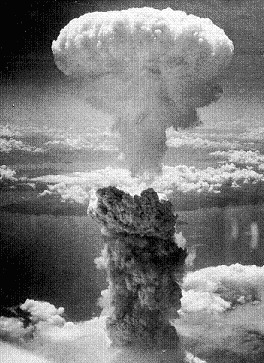
Yesterday (August 9) was the anniversary of the 1945 atomic bombing of Nagasaki, the second and hopefully final time nuclear weapons have ever been used in anger.
The American use of nuclear weapons remains one of the great historical controversies of the 20th Century.
The orthodox position in the U.S., the traditional mixture of jingoism and selectively read evidence, is that the atomic bombings were necessary to bring the war to an end and saved tens of thousands of American (and Japanese, for that matter) lives. In 1945 my grandfather's tank battalion was in California practicing beach landings, and I don't think they were intending to invade Brazil. Because so many people in America can say that about their father or grandfather, this argument tends to be persuasive. Furthermore, there is little doubt that Operation Downfall would have produced horrendous casualties, a point which is usually enough to convince the casual historian of the Necessity of the atomic bombings.
Of course, if one has any but the most superficial understanding of the War it rapidly becomes apparent that this is a weak explanation. Conventional bombing, combined with the almost entirely successful Operation Starvation submarine blockade, could have accomplished the same thing. How many people realize that fewer people died at Nagasaki (80,000) or Hiroshima (~90,000) than in the largest conventional bombing raid on Tokyo (125,000)? By 1945 Japan had essentially no ability to defend itself from aerial attack. They could barely feed themselves let alone build and fuel planes, not to mention teach people to fly them effectively.
This leads us to the most prominent explanation among the cynical – the Scare the Russians argument. There is probably some truth to the claim that the military and political classes in the U.S. wanted to obtain Japanese surrender before the Soviets, who were rapidly charging across Siberia to invade Japan from the north, could reach the islands and thus stake a claim to post-War Japan. This probably would have led to West/East Germany or North/South Korea situation in Japan. This is a decent argument but it is incomplete.
Speed was a major concern, but the Soviet Union was only part of the problem. To understand the real need to end the War quickly, one must come to grips with the fact that Tom Brokaw and his Greatest Generation franchise are absolutely full of shit. Shocking, I know. This will be quite a leap for many of you to make, but close your eyes and imagine a world in which The Greatest Generation was basically the same as any other. The U.S. needed to end the War quickly because the public was rapidly getting sick of it. Truman and Co. needed to end it because the political will to fight for another year or two simply wasn't there.
A few historians – most notably Kenneth Rose (Myth and the Greatest Generation), Joseph Ellis, and Arthur Schlesinger Jr. – have tried but failed to pierce the powerful cloak of revisionist nostalgia that is draped over WWII in our collective memories, often suffering damage to their reputations in the process. But it the cultural myth of the America that was unanimously in support of Total War and making the attendant sacrifices simply wasn't there.
The men and women who stayed behind were fully immersed in the war effort. They worked long shifts, rationed gasoline, and ate less meat. They rolled surgical dressings for the Red Cross and collected cigarettes for the boys 'over there' (p. 87)
That just isn't true. Not even close. Yes, many Americans fit this description (and everyone alive thereafter tried to claim that they were of this mindset during the War) but many did not. There was a rampant black market on which people obtained the rationed goods they supposedly sacrificed. Absenteeism from war work was beyond rampant. Millions dodged the draft in one way or another.
Adultery, divorce rates, and juvenile delinquency (as the draft and women's entrance into the war workforce left millions of kids unsupervised) skyrocketed. The labor force ruthlessly exploited the dire need for military production to extract money for employers before abandoning those jobs for a new, better paying one. In short, even the small sacrifices that Americans were asked to make on the "Home Front" during the most important war of the last few centuries were too much for a lot of them to bear.
It stands to reason that many of the most "enthusiastic" or patriotic Americans signed up for service in one way or another, leaving war production work to those ineligible for service (women, the elderly, the very young, etc.) and the malingerers and opportunists. Those who were compelled by law or conscience to fight did so. Those who thought it might be more fun to stay safely at home making a killing in a labor-short market and banging the wives of servicemen who were overseas did so as well. That's the part that Brokaw and his followers prefer to forget while glorifying themselves – most of us are assholes, whether in 1945 or 2010. With WWII veterans dying at the staggering rate of about 1,000 per day it may not be long before we can take off the rose colored glasses and see the War to End All Wars in the cold light of reality. America resorted to a weapon of unprecedented danger in order to bring the War to a rapid conclusion, not only to save lives in an invasion and scare the Soviets but also in recognition of the political reality that the country was no longer willing to tolerate the most superficial sacrifices for much longer despite the vast economic incentives for doing so.