TRUST

Posted in Rants on April 28th, 2010 by Ed

"Just as Americans in general do not have the habits of deference, so the conservative in America does not have them either. Ultimately he does not defer even to the country’s institutions. If one of these institutions, such as the Supreme Court, makes decisions he detests, he will defame that institution. He is as ready as is the common man to bypass the institutions he ought to defend."

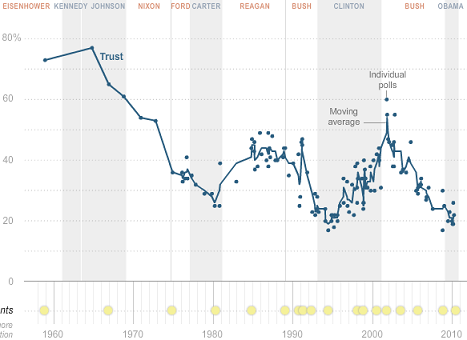
Recently in my public opinion course we've talked about the substantial research detailing the precipitous decline in levels of trust in the government in the United States. Data from the Pew Center and the National Election Studies illustrate this point quite clearly:

When I see this data many potential explanations come to mind – researchers usually identify the end of post-War prosperity around 1970, the Vietnam War, and Watergate as primary culprits – but I always think of the quote at the beginning of the post. It is from British conservative Henry Fairlie. He wrote it in 1980 at the Republican National Convention in Detroit as he watched the dumbing-down of the American right culminate with the nomination of a B-movie actor turned Goldwater acolyte turned soft-seller of neoconservatism.

I've made the following point many times previously, but the American right used to have an image problem. They still do, of course, but it is a very different one today. Prior to Reagan, the stereotype of American conservatism was a handful of wealthy white men in tuxedos sitting around a country club drinking expensive cognac. It was snooty. It was elitist. It had unshakable faith in the fundamental goodness of our nation and its institutions. Fairlie was prescient in noting how rapidly this would change with the ascension of the Hero of the Common Man – "common", in reference to voters, inevitably meaning "stupid." The party of East Coast industrialists became the party of yokels, rubes, creationists, xenophobes, and assorted other knuckle-headed bottom dwellers in this vast country. They still have an image problem, but now it is that the word "conservative" conjures images of Glenn Beck and some Teabagger screaming idiocies through clenched teeth while holding a misspelled sign.

It certainly can't be the fault of the right alone that trust has fallen so dramatically over the last three decades, but Fairlie identified the reasons why they shoulder a good deal of the blame. I'm not British enough to use a word like "deference" to describe their problem. It is more accurate to say that they lack any respect at all for our institutions and have gone far out of their way to convince Americans that if the government is not doing exactly what you want at all times, then the system has failed and it becomes a legitimate target for torrents of seething rage.

If the government spends money on something that does not directly benefit you, then taxes are evil. If your candidate loses an election, elections are ACORN-choreographed frauds. If Congress passes a law you do not like, then Congress is an illegitimate institution and your Governor should start talking about secession. If someone interprets the Constitution differently than you do, then the Constitution is being shredded by traitors and socialists. If a person who does not look like you becomes president, then he must be a foreign usurper. And of course one's faith in all of these same institutions is restored and manifests itself with great enthusiasm as soon as things are back to the way you want them.

Our country is worse off, in short, because of the right's "southern strategy" of appealing to the lowest, basest instincts of the masses, vilifying the very institutions they hope to control. It is not a coincidence that we hear the word "secession" every time they are out of power, because any institution that displeases them is slandered as illegitimate. I do not expect that we can recover the level of "Gee Ain't America Great!" sentiment that existed in the 1950s, but it would be nice if American conservatism would stop working quite so diligently to convince the public that it is not only acceptable but also one's duty to profane our system of government every time it acts contrary to the wishes of the average rural Texan.

Tags:

BUT IT'S A REALLY IMPRESSIVE PHONE

Posted in Rants on March 15th, 2010 by Ed

The speed with which most academic research is obsoleted, especially in the social and behavioral sciences, is something of a punchline. It is deserved to some extent, but there are a number of "classics" in any field which stand the test of time. In political science, McCubbins and Schwartz produced their seminal work on Congressional oversight in 1984 and it hasn't been improved upon in the intervening years (although Aderbach's Keeping the Watchful Eye from 1990 expands upon it). If this paragraph has thus far caused your eyes to glaze, I promise this is more interesting than it sounds.

Congress is constantly delegating authority to various Federal agencies – the EPA, Securities and Exchange Commission, FDA, etc. – and one of the fundamental questions of politics is how (or if) Congress can control them after handing over the keys. Staffed largely by unelected (and un-fire-able) civil servants, the agencies are something of a leviathan and Congress can very quickly lose control of policy. Traditionally it was thought that oversight required Congress to hover over the agencies and crack the whip when they deviate from their mission. Yet there is no evidence that this happened, so it was widely assumed that Congressional oversight was limited at best.

McCubbins and Schwartz relied on a very old concept – classic Madisonian pluralism – to solve the puzzle. Their analogy, not to mention the title of the paper, is "Fire alarms vs. police patrols." The police engage in costly hands-on oversight. They cruise around looking for crimes being committed and, provided the offender is black or Latino, they chase after them yelling, "Stop, evildoer!" This is time- and labor-intensive. It costs a lot of money. But preventing crime is judged to be worth the cost. The fire department operates much differently. They don't cruise around looking for fires. They are organized to respond quickly, but only when someone says "Hey, there's a fire!" In this scenario, you and I are effectively the regulators.

This idea was intended to describe how Congress monitors regulatory agencies, but it has come to accurately describe the behavior of regulators themselves. This is partly by design – Reagan-era ideas about "getting government off our backs" – and partly of financial necessity. The public and interest groups become the regulators, sounding the "fire alarm" when necessary. It's not always a great system. The Food & Drug Administration (or the FAA, or OSHA, or whatever) has nowhere near enough people to do police patrols, actively seeking out safety violations. So they respond to fire alarms, i.e. a few dozen people get e.coli, someone loses an arm in a kick press, or a plane goes down. Both the regulatory agencies and the Congress that ostensibly monitors them are designed to react, not to prevent. Neither the political will nor the resources to engage in preventative regulation exist.

OK. Now the point.

Mike draws our attention to an old Baseline Scenario piece on the House GOP version of financial reform, which is relevant because what is about to come out of the Senate is really, really similar:

…creates an Office of Consumer Protection within the [Financial Institutions Regulator]. The Office of Consumer protection is responsible for all consumer protection rulemaking under the Consumer Credit Protection Act, and will coordinate with the other divisions of the FIR in enforcing consumer protection. Establishes a consumer complaint hotline for the timely referral and remedy of consumer complaints, regardless of charter type or regulatory structure. Requires the Office of Consumer Protection to use extensive consumer testing prior to the promulgation of new consumer protections. Requires a comprehensive review of consumer protection rules and regulations on a regular basis with reports to be issued to Congress based on inaction or action with regards to consumer protection standards.

So the GOP idea of regulation is a hotline, a phone in the basement at Treasury. We wait until something devastating happens and then we spring into action…by calling this number and saying "Hey, something devastating happened!" well after the opportunity to do anything meaningful has passed. N.B. the cute language about "testing" regulations and doing a periodic review so Congress has a regular opportunity to cut whatever the banks are complaining about.

It is entirely understandable that Congress oversees regulatory agencies in this manner. Their time is finite and the demands for their attention are many. For the agencies themselves, however, this is demonstrably the worst possible way to regulate. It gives us little more than good autopsies; the role of Federal agencies is to show up after the fact and explain the disaster they failed to prevent. So what we are getting in terms of financial reform (and I defer the nuts/bolts to Mike) is a regulatory body that will be empowered to do little except write a nice, detailed 9/11 Commission Report for the next crash. If we can't regulate derivatives I guess that's the next best thing, right?

Tags:

BOXING vs. WRESTLING

Posted in Rants on December 8th, 2009 by Ed

Bruce Miroff makes one of my favorite arguments about the presidency in political science literature in "The Presidential Spectacle" (only available in print, unfortunately). In that piece he described the fundamental dilemma of the modern presidency as its dual nature; the institution requires substance but the public demands style. He uses the great analogy of boxing and pro wrestling. Doing one's job as president is like boxing, a contest of strength, strategy, and will. Passing legislation or making military decisions, for example, are actions with uncertain outcomes. Whether they succeed or fail depends on how good he is. Winning public support, on the other hand, is pro wrestling – it's all about style, gestures, and ridiculously simple morality plays with a clearly identifiable villain and a predetermined outcome. Who wins or loses does not depend on skill. It's about mugging for the camera and making the right gestures.

The invasion of Grenada is the classic example of such "presidential spectacle." We are the Good Guys; the godless Commie Menace is the Bad Guy. Cue the footage of American military might kicking ass and getting home in time for supper. Good guys win, bad guys lose…an outcome that is not only identical to every WWF storyline but one that was never in doubt. The first Gulf War, the War on Drugs, the invasion of Panama, and so on would all be good examples as well. Presidents need this type of song-and-dance routine to reinforce what Americans believe about themselves, just as the wrestling crowd is expected to see itself in the (white, mulleted, profane, "All-American" hillbilly) Good Guy and revel in his trouncing of the (black, Mexican, Muslim, or effeminate) Bad Guy.

It was interesting to see how the right would react to Obama caving in on Afghanistan and agreeing to send 30,000 troops (instead of the 40,000 they asked for – ooh, take that!). You knew they needed to find something to bitch about even though the right got what it wanted…open-ended and escalating commitment. For a while it appeared that the best they could do was whining about "dithering" and taking too long to make the decision. That is a lame complaint, albeit not without merit. The appearance of indecisiveness is always punished in opinion polls. Fortunately Krauthammer came along and said what I knew they were all thinking; it was a simple matter of waiting for someone to say it.

We know that the kind of spectacles I described earlier are popular – an American president striding around in a flight suit and declaring to one and all that America just kicked the Bad Guy's ass. We also have quite a problem with blurring the line between entertainment and war. There is an unreasonably large number of Americans who love war. They get off on it. They watch The Military Channel eight hours per day and believe the appropriate response to everything is nuke those motherfuckers (or at least carpet-bomb them). It is entertainment for them, and it bolsters their lousy self-image and latent self-loathing to picture America as some sort of Charles Bronson / Rambo figure strutting around beating nations who don't Do As We Say with his enormous penis.

That's really what Krauthammer is getting at, what he felt was the fundamental problem with Obama's speech: the President was so dispassionate. Where was the sophomoric bravado, the manly chest-pounding, the cockiness, that America Fuck Yeah swagger that all the doughy, impotent Bush voters need in order to get off? Why didn't Obama look excited about war? Why didn't he don a flight suit and declare "We're comin' to kick your ass"? Why didn't he jump on the podium, stare straight into the camera, and challenge Hacksaw Jim Duggan and the Iron Sheik to a cage match at this year's Summer Slam?

It's sad enough that they derive so much pleasure from watching gun camera footage and endless cable TV shows about tanks and bombers blowing shit up (not to mention the endless gun pornography). But to watch the President substantially escalate our commitment to a quagmire – to basically throw 30,000 more people into the meat grinder for no apparent purpose – and then whine about how he didn't look excited enough about it is…well, it's sick. I lack a better or less controversial word for it. Whether they need the image of America-as-Rambo to compensate for their own shortcomings or they simply get a big woody every time they think of war, this portion of the electorate wants Stone Cold Steve Austin as President. Rather than demanding to see more war swagger from Obama they should demand to see a psychiatrist.

Tags:

NATURAL EXPERIMENT

Posted in Rants on December 2nd, 2009 by Ed

Two days in a row on political science-related topics. I promise I won't make a habit of it.

People in the social and "hard" sciences like to snipe at one another – they do "real" science with microscopes and Bunsen burners, while we retort that we study things people actually give a shit about rather than tyrosine-specific kinase proteins. One undisputed advantage the chemists and biologists have is the ability to conduct really well controlled experiments. An experiment isn't the only way to study something, of course, but it's pretty cool. Political scientists try to do experiments and some people get a lot of mileage out of it, but you can't really simulate an election or real world decision-making. But we get to do natural experiments. Which is like having someone else do half of the work for us.

If State A adopts voting machines but States B and C stick with paper ballots it sets us up to test hypotheses about the effects of different voting technologies on turnout, wait times, or whatever. Or, to use one prominent example, Nebraska has a unicameral, non-partisan state legislature while every other state has a bicameral legislature with parties. So in comparing the different systems in action we have an opportunity to study a lot of different aspects of the role of parties in the legislative process. Since we can't recreate politics in a lab or control everything we would like in our research, we have to be a little more creative and take advantage of opportunities where they exist.

Now that the President has predictably bowed to pressure and sent another 30,000 people to get shot at in Afghanistan to accomplish…whatever our goal is over there…it is going to be really interesting to watch the poll numbers about the war over the next year. Right now and for the past several years there has been a fairly lopsided partisan distribution in opinions about Afghanistan, with Republicans urging us to "listen to the generals" and send more troops, Democrats opposing it, and independent flipping a coin as usual:

afghanpoll

Something tells me that if we revisit these numbers in December 2010 we'll find that a lot of Republicans are suddenly very dissatisfied with the direction of the war and stridently opposed to committing more resources to it. Are the Democratic numbers going to change as well? I'm a little more skeptical on that one. If anything I think the President is going to find himself increasingly unable to hold his party together, as Bill Clinton did, the more aggressively he reinvents his agenda as Republican Lite, as Bill Clinton did. The specifics of the situation are lost on everyone answering these poll questions, of course – nobody has any idea what's going on over there or what we're supposed to be doing (note this hilarious expression of what Americans believe our goal is). That's pathetic, of course, but why let facts or knowledge thereof get in the way of a knee-jerk partisan response?

Tags:

THE DELUSIONS OF CROWDS

Posted in Rants on November 30th, 2009 by Ed

One of my formative political experiences, and one which almost single-handedly convinced me to pursue political behavior as an academic career, occurred in 1998 in a class I hated. More accurately it was in the class of a professor I hated, the resident expert on constitutional law and chasing 19 year old tail at the University of Wisconsin.

Madison is a remarkably liberal place, so it was no surprise that very liberal and openly lesbian Congressional candidate (now Representative) Tammy Baldwin was extremely popular on campus. Aside from her ideological compatibility with the average Madison resident her campaign was well-organized, hosting "Tammy Baldwin dance parties" that drew huge numbers of students with no particular interest in politics. So it was a safe bet that any classroom at UW in the Fall of 1998 was about 85-90% Baldwin supporters.

Professor X began class one day – a large Con Law lecture of about 180 mostly future law school students – and asked for a show of hands on the question, "Which one of the two candidates for Congress is more likely to vote to lower taxes?" A solid 90% of the hands went up for Baldwin, with only the remaining 10% choosing her Republican opponent (the forgettable Jo Musser, who I remember for some reason over a decade later). Now, Tammy Baldwin was and is many things. But by no stretch of the imagination was she an anti-tax hawk. In fact she explicitly stated that she was not opposed to increasing taxes if necessary to pay for expanded Federal programs. Musser was the typical cut-taxes-at-all-costs Republican who made lowering taxes the cornerstone of her campaign message. So this was not a subjective question. There was a wrong answer, and 90% of the class chose it.

This was the exact moment at which I realized that the mental calculus of the average voter goes something like:

Me like Baldwin.
Me like tax cuts.
Baldwin is for tax cuts.

People who study political behavior understand, from as far back as The American Voter in 1960, that party identification is the key to this kind of "reasoning." Partisanship is a screen through which all incoming information is filtered. Republicans will tell you that everything they like is a Republican idea and everything they hate is what Democrats stand for. After decades of contorting research in an effort to give American voters a little more credit for intelligence, the field has come full circle and once again embraced the idea of partisanship as a "fundamental part of an individual's identity" (Partisan Hearts and Minds) like religion or ethnicity. The overwhelming majority of us acquire a partisan identity in adolescence or early adulthood and interpret the rest of the world through it thereafter.

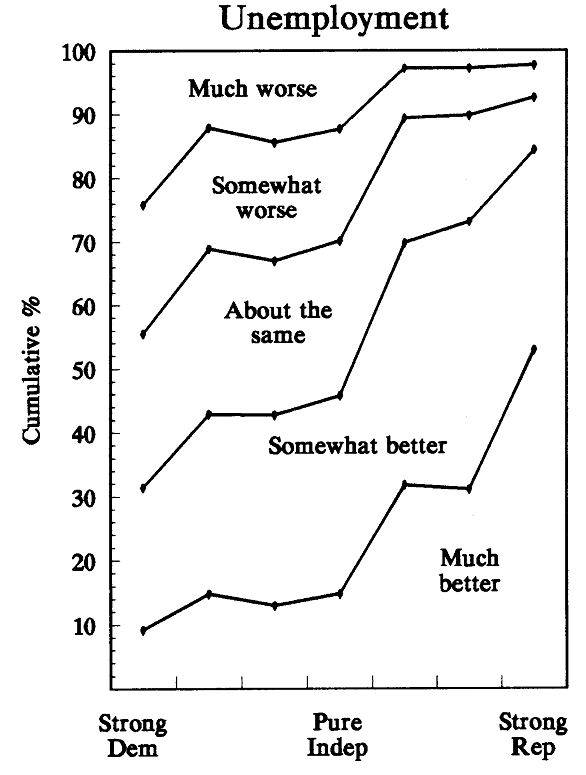
Why is this relevant? Well, as Krugman pointed out, this is relevant to understanding the folly of pursuing "deficit reduction" as a political strategy by the White House, to which I would add the strategy of appeasing conservative Democrats or any Republicans on health care. Republican voters, most of whom hate Obama, will believe that he made the deficit bigger and that his health care plan is a disaster – even if the deficit is demonstrably smaller. Democrats will say the opposite. Really. How do we know? Because this is exactly what happened to Bill Clinton, as Achen and Bartels demonstrate.

achenbartels

Voters don't actually know anything. This is widely understood and constitutes one of the few points on which political science research is nearly unanimous. If Obama, like Clinton, destroys the deficit, Republicans and "independent" voters will not realize it. Hell, even some Democrats won't realize it. What people DO realize is when their own circumstances improve or worsen. Anything nebulous or intangible like deficit reduction will be lost on them, but they understand unemployment or failing banks. So in political terms, if the President thinks he can jump start the economy by racking up an enormous deficit he should do so. No one will know if it increases or decreases – voters will simply fill in that information according to their partisan identification. But many of them will know if unemployment falls, interest rates for auto and home loans fall, or their 401(k) recovers. If a health care bill provides coverage to people who could not previously afford it, it will be a net benefit.

Do things that improve people's lives and you will find yourself politically rewarded. Achieve abstract goals in an effort to appease people who hate you and you will find the victory quite hollow.

Tags:

INDEPENDENCE FROM REASON

Posted in Rants on August 31st, 2009 by Ed

Like any President taking office with impossibly high expectations and in the middle of a serious crisis, Obama's approval ratings have declined steadily since Inauguration Day. It is easy to look at the aggregate numbers and start jumping to conclusions but the partisan breakdown is far more interesting:

Image Hosted by ImageShack.us

Image Hosted by ImageShack.us

Image Hosted by ImageShack.us

Essentially there has been no change among Democrats. The trend is nearly flat. Republicans have behaved predictably. Frankly it's amazing that Obama had a 35% approval rating among that group nine months ago, and it was inevitable that the moment he did anything one might expect from a generic Democratic president that modicum of support would disappear. Independents show the same trend as Republicans. The magnitude is different, obviously, but the pattern of immediate and gradual decline of support (and increase in disapproval) is identical. Why?

Political science may not have revealed everything about the mind of the American voter, but we do know that "independent" doesn't mean what the media thinks it means. It is important to understand the loaded meaning of the term, the prevalence of social desirability effects (the tendency of survey respondents to give the answer they feel is expected of them or is most socially acceptable rather than an honest answer), and the scant attention most Americans pay to all things political. In this context, "independent" means any of the following:

  • 1. A person whose ideological preferences legitimately lie between the two major parties. These are True Independents, and this is what pundits and political figures have in mind when they use the term. But there is no evidence that they form a majority of the Independent group.
  • 2. "I don't know." When someone asks you a question to which you don't have an answer "Independent" is a convenient out. Few adults are keen to admit that they pay absolutely no attention to politics.
  • 3. Republicans who are tired of Obama-lovers giving them crap about being Republicans. The same effect would have been in play in 2003-2004, when voters to the left of Goldwater might have chosen Independent as a way out of conversations they didn't want to have with their yellow ribbon-clad friends and co-workers.
  • 4. People who have a strong ideological preference but think that being Independent makes them look cool. Seriously. There is a psychological benefit people can derive from declaring that they are Independents, i.e. free thinkers who are open-minded and unwilling to submit to a party label or to follow crowds. If you don't think independence and individualism are loaded and comoddified terms, watch Nike and soft drink commercials for an hour and get back to me.
  • 5. Something I like to call "Dr. No Syndrome" – people who oppose everything, including the major parties. No matter what Obama does, these folks won't like it. Government is bad, the parties are bad, the media is bad…

    When we understand what Independent really means, graphs like the ones shown above make more sense. Democrats stand by their man. Republicans surrender whatever hope they had of Obama being a Republican. And Independents are an amalgam of the angry, the ignorant, the dishonest, and the legitimately moderate. The last group receives the most attention and their motivations are imputed to all voters who call themselves Independent. The media's willingness to assume that all Independents are thoughtful moderates is but more evidence of how favorably the concept is looked upon in our society. Phenomena like the tendency of Independents to be strangely hostile to Democratic presidents or the seemingly random fluctuations of opinion within the group are an artifact of its status as a catch-all category for voters with very different motivations, levels of information, and ideological preferences.

  • Tags:

    PERSUASION

    Posted in Rants on August 25th, 2009 by Ed

    I am far from an expert on the presidency, although I do hope for my students' sake that I have a decent understanding of the office and its powers. Like the vast majority of people who teach it, I subject my students to Richard Neustadt's Presidential Power and the Modern Presidents. Students hate Neustadt. I mean, they loathe it. The book is 49 years old, laden with references to names and events of the 1950s for which today's reader has little context. Worse, his dull writing style reads like the owner's manual for an appliance. But we can never get away from Neustadt because he nails the fundamental dilemma of the presidency (and its solution) so completely.

    Briefly, the expectations on the modern president are far greater than the powers of the office. There is an "Expectations Gap" wherein the public expects President Obama to fix a lot of things he lacks the power to fix. The president's control over the economy is indirect at best and his role in the legislative process is extremely limited. When Candidate Obama promises health care reform, what he does is paint himself into a corner from which he must find some way to get Congress to provide reform. He can't just do it himself. Most of us realize this.

    The academic study of the presidency is largely a matter of explaining how presidents overcome this gap – how to get done what the powers of the office do not allow. Neustadt's answer? (This is where my former students start having flashbacks and chanting the answer without being fully aware of doing so). Persuasion. Presidents have myriad tools at their disposal for persuading Congress to do their bidding. Note well that this is not talking about persuading the public, which is a different animal altogether. He means persuading the people who matter most.

    The discomfort with Obama's performance which has been gnawing at me since January 20th has nothing to do with betraying ideology. He simply does not appear to understand how to get things done as President. Congressmen and Senators are persuading him, not vice-versa. I almost wept with joy upon reading the comments of Tom Johnson, who served a President who understood persuasion like no other ("What LBJ Would Do.") He is right. On every single point he is right. Without realizing it, I assume, he is summarizing Neustadt's view of presidential power. It is the power to persuade Congress. We can throw out all of the justifications we want – and I've trafficked in a few on this site, like blaming the spread of right-wing media – but despite all of it, LBJ would get this motherfucker done. And it would be as he wanted it, not as some watered-down piece of compromise legislation.

    Image Hosted by ImageShack.us

    This is a picture of LBJ brow-beating a Senator – almost literally – into falling in line with the White House agenda. He was the undisputed master of this, a technique his colleagues came to call "The Johnson Treatment" (insert joke here). But he was not always aggressive. He could flatter, beg, connive, threaten, or whatever else he knew would work on a given member of Congress. His specialty was members of his own party who refused to fall in line – a problem Obama should recognize. More often than not LBJ put the fear of God into them. He laid out in no uncertain terms that the president can be either a guardian angel to a Congressman or the angel of death. His skills at bartering and log-rolling were legendary, but when those failed he had no qualms about being harsh. He made threats that were both clear and credible.

    Barack Obama's problem is not "Blue Dog Democrats" – in the Kennedy/Johnson era the Democratic Party had a large southern wing far more conservative than any Blue Dog and most of today's Republicans. Nor is the problem Glenn Beck, the minority party in Congress, or the insurance industry. The problem is that he does not appear to understand how a president gets what he wants. The solution certainly isn't town hall meetings and public relations campaigns aimed at clearing up the misconceptions of the ignorant. The solution, in colloquial and thoroughly gender-insensitive terms, is to stop being a damn pussy. Lay into recalcitrant Reps and Senators around the clock until he has the votes he needs. It is hard work and he needs to do it. He can continue to allow Kent Conrad and Bill O'Reilly to control his agenda or he can choose his priorities and get what he wants.

    Image Hosted by ImageShack.us

    Look at the photos. Can you picture Obama doing this? I can't. I wish I could talk to the guy for ten minutes to communicate the fact that he, and no one else, is responsible for the content and fate of health care reform legislation. LBJ might have stayed awake for five days straight, shattered a few friendships, and given himself an ulcer and two heart attacks in the process, but he would get it done. He would get it done because he'd decide that it is important and therefore worth any sacrifice. Following his example would require only an understanding of the powers of the office and the willingness to push oneself to the limit. Which does Obama lack?

    Tags:

    DIE CAST

    Posted in Rants on January 29th, 2009 by Ed

    How do we explain the House Republicans' behavior on the stimulus package vote? Their behavior is irrational. Or rational. One of the two. Well, it depends on what we consider rational.

    Woefully outnumbered in a legislature in which the simple majority dominates, the logical course of action for the House GOP would seem to involve cutting the best possible deal with realistic expectations. The Democrats have an 80-seat majority. When the GOP threatens to hold its breath until it gets what it wants the inevitable response is "OK, good luck with that." There is absolutely no incentive for a majority that large to negotiate with assholes. If the minority feels like behaving, i.e. recognizing that they can't dictate the outcome with 188 seats out of 435 and making a few demands, it is worthwhile for the majority to logroll and make a few concessions to build goodwill for future conflicts. But if the GOP expects to get its way by pitching hissy fits they are simply going to get bypassed. Hence they are irrational.

    They might be rational, though, depending on how rational you consider the Gingrich Plan.

    The Gingrich Plan originated circa 1986, an era in which the GOP was not only the minority but had been the minority for decades. The party's strategy was to play along and take what they could get from the majority. Newt, an unknown at the time, disagreed. He urged the party to oppose the Democrats tooth-and-nail on nearly every issue and eventually the public would be persuaded by the inherent correctness of the Republican alternative. Because of the Republican takeover of 1994 the Gingrich Plan was widely hailed as a success. It might be a good minority strategy, but it's really a dice roll.

    Their logic today is that getting a few concessions is not that valuable because it gets them a share of ownership in case of failure. By having voted against the bailout in unison it is owned by the Democrats entirely. So they are essentially making a huge gamble that the stimulus legislation is going to fail. They're rolling the dice that it will be a big disaster and they can beam smug we-told-you-so smiles to a voting public that will come begging for the GOP alternative. In short, if the GOP:

  • supports the stimulus and it succeeds, the Democrats get 99.9% of the credit anyway
  • supports the stimulus and it fails, they share the blame
  • opposes the stimulus and it succeeds, the Democrats get 100% of the credit anyway
  • opposes the stimulus and it fails, the GOP gets credit for having opposed it

    Of those four options they obviously chose the correct one. "Correct" in terms of their own interests. Note, however, that they chose an option that involves them rooting really hard for America and the world to spiral into a Depression unlike anything we've seen in 100 years. You know, just like they hope really hard for a terrorist attack so that they can wring out a few more votes.

    America First!tm That's the GOP. Every single time.

  • Tags:

    INTERNONYMITY

    Posted in Rants on January 14th, 2009 by Ed

    A colleague raised an interesting point not terribly long ago.

    Everybody googles everybody, right? If you're an employer seriously considering hiring someone, unless you happen to be 65 or Amish it's likely that you'll see what Mr. Internet has to say about John or Jane Doe. This is why many people cloak themselves in the anonymity that the internet allows. If you want your very own website about your regular conversations with extraterrestrials, it is reasonable to expect that you might not want the boss to know that you are insane. So John Doe becomes "John in Texas" or "AlienGuy01", author of AlienBlog.net. If you feel like becoming a regular commenter at PissInMyMouth.com, you wouldn't post as "Mary Jones, Public School Teacher from Pittsburgh" would you? Of course not. It's common sense.

    Mike, the guy who used to live here and now lives here, politely asked that I not use his last name when I re-designed the site. Another regular poster, who may get involved with my exciting new side project BillKristol.net (coming soon!), was explicit about the work-related need to conceal his identity. One of the members of my band is, for identical reasons, quite enthusiastic about not using his real name. These examples are the norm. In a society in which a lot of people take offense to language or subject matters more risque than a Leno monologue, it makes perfect sense.

    Which raises an interesting question: why don't I take advantage of internet anonymity? Blogging is particularly dangerous for academics – at least this kind. People have been denied tenure over blog-related controversies. And as my colleague recently pointed out, it's entirely possible that members of hiring committees google me and find this site. Then 90 seconds later my file is in the trash. Maybe that's paranoid. Both academics who blog and the Chronicle of Higher Ed insist that it happens. To wit:

    Job seekers who are also bloggers may have a tough road ahead, if our committee's experience is any indication.

    You may think your blog is a harmless outlet. You may use the faulty logic of the blogger, "Oh, no one will see it anyway." Don't count on it. Even if you take your blog offline while job applications are active, Google and other search engines store cached data of their prior contents. So that cranky rant might still turn up.

    I don't know how much stock to put into such talk. Regardless, I would seem to be an excellent candidate for keeping things incognito. Students, for example, could find this website and, with little effort, assemble a Magna Carta-length list of material for formal complaints.

    I've certainly thought about all of these issues and considered the potential consequences of my daily bursts of profanity and dick jokes. Here's the thing. I don't give a shit. I'm not ashamed of anything I've ever said or thought in this context and I don't really care who wants to read it. Moreover, I have two big issues with the academic bias against blogging.

    First, it only seems to be a problem when someone has a blog that offends the Talk Radio crowd. It's OK for Glenn Reynolds to essentially be wrong about everything and distort reality to fit his shrill talking points so long as he doesn't tick off David Horowitz and Glenn Beck. Hell, it's OK for John Yoo to be on faculty while simultaneously, you know, being a war criminal but heaven forbid someone has a blog where they use words like "fuck." Lying and distorting the truth are acceptable. The line must be drawn at the moral evil of swearing, though.

    Second, this anti-blog bias represents a very petty and narcissistic side of some tenured (hence older) academics. They react very angrily and with considerable bitterness to the idea that anyone could care about what one of their underlings (grad students, untenured assistant profs, or, god forbid, even an undergrad) has to say. I have a modestly successful blog with a consistent base of readers now in the high triple digits. Believe me, that really bugs people who have dedicated their careers to creating a huge academic output that absolutely no one cares about. Academics publish incredibly compartmentalized work in journals no one reads. In a month more people read a decent blog than will ever read the output of most tenured academics in a lifetime. And most importantly, the blogging format circumvents the gatekeeper function of the academy. The idea that a lowly grad student could write anything without the Elders first giving it a stamp of approval…well, it's practically academic heresy.

    So, screw it. At this point I'm in way too far to backtrack anyhow. Regardless, I take solace in the fact that I am a flat-out terrible academic and no one would hire me sans blog either. This thing makes me happy, and if I'm going to be unemployed or driving a bus for a living I might as well do what makes me happy.

    Tags: