NULL POLICY

This Salon piece on "The final nail in the supply side coffin" is making the rounds, which is great inasmuch as anything pointing out that corporate profits are quite robust during our wageless, jobless, pointless Recovery is a good thing. That said, I have a bone to pick. As ready and eager as I am to mock the ridiculous sorcery that is Supply Side Economics, I am even more eager to object when people use such phrases as slogans rather than to refer to a specific set of ideas.

online pharmacy buy doxycycline online no prescription pharmacy

While cutting corporate taxes is a supply side idea – and since no one has to pay them anyway it doesn't much matter what the rates are on paper – cutting the individual income tax isn't. And that has been our primary, if not only, economic policy preference since the 1970s.

Cutting the income tax is a demand-side solution. And that – far moreso than actual supply side ideas – has proven useless in spectacular fashion as a driver of economic growth. The theory is to give wage-earners more money to spend, which is great except that A) most wage-earners are already paying so little in Federal income tax that the cuts have little substantive impact, B) cuts are always lavished on a small population of high earners who are more likely to save than spend, and C) the civil religion of debt repayment, coupled with staggering levels of household debt, ensure that income tax cuts are just a way to funnel some money to banks and mortgage lenders.

We could talk all day about the pluses and minuses of various economic policy prescriptions. Instead, the debt ceiling nonsense brings up a much more interesting issue: the Obama administration, perhaps even more than any previous one, casts in high relief the fact that the United States does not have bad macroeconomic policy. It has no coherent economic policy at all.

Let's say you have a restaurant. It's an Indian takeout joint. Business isn't going well, so you try lowering your prices. Then you try increasing them. Then you try adding a frozen yogurt bar in the front lobby.

Then you change the entire concept from Indian takeout to neo-American bistro cuisine. Then you change back to all Indian food but you change the name to P.J. Pickleshitter's BBQ Pit and Family Restaurant. To say that you would have a bad business plan would be inaccurate because you have no business plan at all. You're just drunkenly careening from one idea to another, none of them related or building upon previous steps you've taken, blindly hoping that something will work.

In the span of two years we've gone from Obama the Keynesian (although he showed his true colors early on by caving and making the bulk of the stimulus useless tax cuts) to Obama the Spending Cutter. Think about that. He came into office with an $800 billion spending package and now he's agreeing to an even larger amount – rumored to be over $1 trillion – in spending cuts. Regardless of how you feel about either of those individually, it's pretty clear that they make absolutely no sense together. None.

When Nixon said "We're all Keynesians now" it wasn't his ringing endorsement of Keynesianism but an acknowledgment of the consistent, dominant idea guiding US economic policy since the 1930s.

What are we now? Neither party has anything that resembles an economic policy, with the Democrats a limp combination of neoliberalism and whichever way the wind is blowing that day and the Republicans pretty much devoted to low taxes as an end rather than a means.

online pharmacy buy desyrel online no prescription pharmacy

Thus we end up with Reich/Clinton DLC horseshit or Frankenstein's monsters like Paul Ryan's "roadmap" combining sharp reductions in government revenues with plenty of big government (military, handouts to key constituent industries like agricultural subsidies, etc.)

Is it any wonder that nothing changes, let alone improves? We can't commit to one economic policy for more than 18 months. Arguably we haven't committed to any policy at all in forty-plus years but instead have approached economic policy buffet style, choosing all the cakes and pies while leaving the nasty green vegetables behind.

YOUR BEST INTERESTS

Twenty three years ago today a massive offshore oil platform near the Shetland Islands called Piper Alpha – responsible for more than a tenth of all oil and gas production in the North Sea – exploded and burned, killing 168 men and leaving 61 survivors in various states of injury.

The disaster was initiated by an innocent enough mistake coupled with bad luck. The day crew shut down a gas pump, which provided electricity for the platform, for maintenance and left a written notice for the night shift that the pump should not be restarted under any circumstances. Unfortunately the night crew did not find the warning, and when the backup pump malfunctioned they attempted to restart the first pump to keep the platform's power supply functioning. The subsequent explosion triggered a chain of events that resulted in the massive fire you see in the video.

The initial explosion was not large enough to destroy the platform, and nearly all of the crew could have escaped with their lives if the disaster ended there. But it didn't. Two other connected nearby platforms, Tartan and Claymore, pumped all of their own gas/oil to Piper Alpha, which in turn pumped it to an onshore refinery. After the initial explosion on Alpha, the other two platforms continued to pump gas (which burns, FYI) because the owners, Occidental Petroleum, was concerned about the costs of shutting down all three platforms. Apparently when oil/gas production is shut down and pumping ceases, it takes many days and a lot of effort to get the process started again. This was despite the fact that two years prior the company conducted a study and concluded that a fire fed by the massive inter-platform pipes connecting Alpha, Tartan, and Claymore could not be extinguished and would result in total destruction.

So the crew supervisors on Tartan and Claymore – clearly able see Alpha burning furiously just a mile away – continued pumping gas to it because their bosses on the phone told them to. Shockingly, a second and even larger explosion followed. Rescue of the Alpha crew became impossible at that point. Most jumped 100 feet into the North Sea, choosing drowning over burning. After the second explosion, the crews on the adjoining platforms finally (and far too late) shut down.
online pharmacy azithromycin best drugstore for you

A third, massive explosion occurred anyway, killing two men on a boat attempting to rescue the drowning crew.
online pharmacy antabuse best drugstore for you

Thankfully most of us don't have to work on anything as unavoidably dangerous as an offshore oil platform.
buy feldene online bloinfobuy.com no prescription

That said, this has been your friendly daily reminder: Your employer has your best interests at heart. The free market, not regulation, will protect you. Do not think; always do as you're told. Remember those three unassailable truths and I don't see what could go wrong.

BILL BENNETT ROLLS THE DICE, WINS AN FJM TREATMENT

It seemed like a good idea to get the requisite Bill Bennett Gambling Addiction joke out of the way up front.

Imagine the year is 1840 and you are the world's foremost expert on phrenology. You have devoted your entire life to its study and promotion. You have defended it well against its many critics. In just a few years it will be rejected once and for all by the medical and scientific establishment, exposing it as the quackery it is. What do you do? You've spent half a century on something that turned out to be meaningless, ineffectual pseudoscience. So you do the only thing anyone can do in this situation: you double down and continue to defend it with a dated laundry list of ludicrous, discredited arguments. Might as well go down swinging. Admitting that phrenology isn't real is to admit that your entire life has been a complete waste of time. And who wants to do that?

So on a completely unrelated note, here's former 1980s Drug Czar and legendary War on Drugs evangelist Bill Bennett on the Frank-Paul federal marijuana legalization legislation! More specifically, "Why Barney Frank and Ron Paul Are Wrong on Drug Legalization." Call the babysitter and get out the camera, because you are about to see some really good arguments. Ready?

From certain precincts on the left, notably Barney Frank, to certain precincts on the right, notably the editorial page of National Review, we are witnessing a new push to end the so-called war on drugs and legalize drug use, starting with marijuana.

Well we almost made it one sentence without factual misstatements. The proposed legislation eliminates federal penalties for marijuana use, meaning that states would have discretion over whether marijuana would be legal within its borders. This is similar to other issues like gambling (to pick a random example) that are legal or illegal on a state-by-state basis.

Indeed, Ron Paul, Barney Frank's co-sponsor in the latest legislative effort, said recently he would go so far as to legalize heroin.

That's libertarian ideologues for you. That's also called a red herring, as Rep. Paul's opinion on heroin is irrelevant to this legislation.

It's a bad idea. My friends at National Review begin their case by stating the illegalization of drugs has "curtailed personal freedom, created a violent black market and filled our prisons."

My God, that's the most intelligent thing I've seen in the National Review since I cut a bunch of articles out of The Baffler and pasted them in a dog-eared copy of the National Review.

But the legalization of drugs, including marijuana, would exacerbate each of these problems.

Let's read this literally. I can't wait to learn how legalizing marijuana will create a bigger black market (Guh?) and put even more people in prison (Buh?)

Starting with the basics, keeping drugs illegal is one of the best ways to keep drugs out of the hands — and brains — of children.

Oh good, the Appeal to The Children fallacy.

Obscenity, another vice that has inspired jihads from many deeply closeted moral guardians, used to be judged by the legal standard of its potential to "deprave and corrupt those whose minds are open to such immoral influences and into whose hands a publication of this sort may fall" i.e., children. This derives from Regina v. Hicklin (1868) in British common law and was adapted by the US Supreme Court, until that body rejected it as an unreasonable standard in Roth v. US (1957). That was 54 years ago, Bill. The Supreme Court said, 54 years ago, that "It might hurt children" is a stupid and overly broad argument.

We know three things here: First, children who don't use drugs continually tell us one of the reasons they don't is precisely because they are illegal. For example, since at least 1975, report after report has found that "perceptions of the risk and social disapproval of drug use correlate very closely with drug taking behavior." When those in the drug prevention community ask teens who don't use drugs why they don't, time and again, the answer comes back "because it's illegal."

In what world does "Kids don't use it because it's illegal" a supporting argument for keeping it illegal? Lots of people would stop using anything if it was criminalized. If there is a good argument to be made here, this ain't it.

This, of course, explains why a greater percentage of teens abuse legal substances like tobacco and alcohol over illegal drugs such as marijuana — even when they say marijuana is easily accessible.

Bill, it's a phenomenally bad idea for anyone spouting Nancy Reagan Just Say No arguments about weed to mention alcohol in the same article…especially to point out that while the War on Drugs continues apace, kids are getting shitcanned on Four Loko and smoking themselves to a lung cancer death at 51. Do I need to explain why you don't want to bring this up when preaching the evils of Reefer Madness?

Second, keeping drugs out of the hands of children is the best way to prevent drug addiction generally, as study after study has confirmed that if we keep a child drug free until age 21, the chances of use in adulthood are next to zero.

McGruff the Crime Dog is apparently under the impression that – ignoring self-selection and selection bias – if we could prevent everyone from using drugs before 21 then no one would ever use drugs. Bill, sit down for a moment: the evidence you cite does not mean that. It does not mean that at all.

Third, we don't need to guess at hypothetical legalization schemes. Our experience with legally prescribed narcotics has already proven it, and we now have an epidemic. This, despite doing everything the theorists have asked, from oversight to regulation to prescription requirements.

Wow, who would have thought that opiates would be addictive, especially if doctors prescribe them like lollipops.

Normalizing, de-stigmatizing, and legalizing illegal drugs lowers their price and increases their use. As a recent RAND study on California found, legalization of marijuana there would cut the price by as much as 80% and increase use from as little as 50% to as much as 100%. Just what California, just what our society, needs.

The RAND study in question states that, "researchers cannot rule out consumption increases of 50 percent to 100 percent." I question Bill's interpretation of that, especially given that the study also states that, "there is considerable uncertainty about the impact of legalizing marijuana in California on public budgets and consumption, with even minor changes in assumptions leading to major differences in outcomes." In other words, you can essentially produce whatever estimates you want by playing the Assumptions Game.

As for the current drug policies curtailing personal freedom, the question is: "Whose freedom?" The drug dealers', sure — the drug consumers, no.

It's going to be cool to see how he makes legalization a negative influence on individual freedom…

As any parent with a child addicted to drugs will explain, as any visit to a drug rehab center will convey, those caught in the web of addiction are anything but free.

Oh for fuck's sake.

I'm not going to deal with the substance of this Appeal to Emotion. Instead I want to talk about one of the most wonderful, happiest places on Earth: the alcohol rehab center! Everyone there is truly free. They are happy as pigs in slop. There are ponies. The ponies fart glitter.

And it is not because of their incarceration or rehabilitation, it is because of the vicious cycle of dependency, waste and brain damage addiction and abuse cause.

Still waiting to hear why this is different than alcohol. Come to think of it, how is it different to ANYTHING addictive? Bill, I'm huffing Scotchgard as we speak and let me tell you, I am in a vicious cycle of dependency and brain damage. The cause of said damage, be it the Scotchgard or your column, is unclear.

Let us make no mistake about this, either: Marijuana is much more potent and causes much more damage than we used to know. Today's marijuana tests on average at more than 10% THC (the psychoactive ingredient). We are even seeing samples of more than 30% THC. This is compared to the relatively lower levels of THC most legalizing proponents were more familiar with in generations past (under 4% in the early 1980s, even lower in the 1960s).

OK. I don't even smoke weed and I know that this is beyond wrong. It makes no sense whatsoever. The argument is that marijuana is like alcohol and THC is like "proof", i.e., 80 proof is twice as strong as 40 proof. But 10% THC is not "twice as strong" as 5%. It might get you high faster (as stronger alcohol in equal amounts would) but it can't get you higher. Past a certain level of THC in the body, additional THC will have no effect. Besides, if people knew what they were smoking (Say, because it has a label on it measuring potency) they might adjust their behavior accordingly.

As for the high incarceration rates for simple marijuana use and possession, it is a myth. As government documentation actually shows, over 97% of sentencing on federal marijuana-related charges is for trafficking, less than 2% is for simple possession. Indeed, the only National Review authority with federal prosecutorial experience that I know of backs this point up: "Actual enforcement is targeted at big distributors. People who merely possess drugs for personal use well know they are substantially safe no matter what the statutes say."

Oh good. As long as the people we're stuffing prisons with are dealers rather than users, then it's all good. If only there was some way to eliminate black market dealers of marijuana other than incarcerating them at ass-breaking expense.

We have had a fair amount of experience with legalization and decriminalization schemes.

Don't forget prohibition schemes! We tried the hell out of that. It worked, right?

Oh.

Citizens are trying to put the genie back in the bottle, from Northern California (where residents have complained that medical marijuana has "spawned crime, drug cartels and teenage pot use")

This is a quote from a single individual with no data provided to support it. Most of the linked article is devoted to people speaking in favor of continued legalization.

to the Netherlands (where drug tourism, use by minors, and border trafficking has increased)

Oh no, not tourism! By the way, which country has a higher rate of recreational drug use and drug-related crimes, Bill?

to England (where apologies have been made for endorsing decriminalization in light of the subsequent growth of teen drug treatment needs)

That's what a conservative takeover will net you. Why not mention Portugal, Spain, Sweden, or any one of a dozen other countries where partial legalization schemes (especially for weed) have been a rousing success?

to Colorado (where easy access has increased demand, "made a mockery" of the legal system, and is increasingly endangering public safety)

In the linked article, the person who gave the "made a mockery" quote is a physician, and the full story says: "She said she would probably favor true legalization but in the meantime is pushing to oust existing pot shops because they're making a mockery of the legal system." Way to misrepresent, Bill. Here's a good knee-slapper from that article, btdubs: "Local law-enforcement authorities are also pushing for a ban, warning that increased marijuana use endangers public safety. Steamboat Springs police arrested 17 drivers suspected of being high on cannabis last year, up from 9 in 2009." Wow, 17! And how many alcohol DUIs? Those local law-enforcement authorities are definitely to whom we should be turning for objective analysis. I mean, what do they have to lose if the War on Drugs disappears?

We have an illegal drug abuse epidemic in this country and it has not been given enough attention. But the cultural messages, as much as the law, matter. When we unified on this, as we once did, drug use went down. When we let up, as we now have, use increases.

Nothing decreased. Not according to the CDC. This is just stupid.

The libertarian experiment promoted as a novel theory by some will only make things worse. More legalization equals more damage, waste, crime and abuse. Not less. That is why it is no time to surrender.

Bill, everyone else surrendered twenty years ago. Reaganite tossers embedded in positions of influence are the only ones yet to get the message.

Let's mention a few things Bill omits in terms of effects of legalization:

1. The lawless narco-state that is Mexico would immediately become 80% less of a war zone, as the bulk of cartel activity centers around that most popular of drugs in the U.S. But, you know, think of the children, man!

2. Legalization would make drug use safer in the U.S. through regulation of its contents, the elimination of violence during the purchase, and the absence of the threat of arrest.

3. Biggest cash crop on the planet short of heroin or the elusive Moon Rock Tree of Mongolia.

4. Apply the Bill Hicks test to the horrors of marijuana usage: if you're at a (concert, ballgame, bar, club, festival) and some bozo is loud, violent, aggressive, and an irritant or even a threat to the people around him, is he A) drunk or B) high on marijuana?

Thanks for playing, Bill. Looks like you're having a great time there in 1986.

THE NEGOTIATOR

For someone who likes politics and devotes the better share of his life to the subject I sure do a great job of ignoring significant aspects of it on occasion. This bothers me. I feel like I should be biting my nails and paying rapt attention to the "negotiations" over the debt ceiling, but I honestly could not care less. This situation is a good example of how Washington politics are starting to feel a lot like Kabuki theater and very little like a functional, representative, multiparty government. We all said six months ago that Obama would cave on Social Security and Medicare, then cave on demanding tax increases, and then cave on any other damn thing the GOP dreams up at the last second and demands with a hearty "Ha ha, what else can we make this idiot agree to?" laugh.

Paul Krugman:

So, here’s where we are on the debt limit discussions: Democrats have agreed to large spending cuts, but are holding out for doing something about:

a rule that lets businesses value their inventory at less than they bought it for in order to lower their tax burden, a loophole that lets hedge-fund managers count their income as capital gains and pay a 15 percent marginal tax rate, the tax treatment of private jets, oil and gas subsidies, and a limit on itemized deductions for the wealthy.

And Republicans walked out.

Think about it. There’s a significant chance that failing to raise the debt limit could provoke a renewed financial crisis — and Republicans would rather take that chance than allow a reduction in tax breaks on corporate jets.

What this says to me is that Obama cannot, must not, concede here. If he does, he’s signaling that the GOP can extract even the most outrageous demands; he’s setting himself up for endless blackmail. A line has to be drawn somewhere; it should have been drawn last fall; but to concede now would effectively mean the end of the presidency.

Let's check back next week to recap how he caved on all that and more. Krugman's comment, of course, overlooks the important reality that even if Obama "draws the line" here he has already given up so much that only in Mushy Centrist Fantasy Land could he conceive of this as anything but a total, humiliating defeat. "Woo! We drew the line at tax breaks on corporate jets!" isn't exactly going to impress anyone. He turned the debt ceiling negotiations, if they can be so called, into yet another round of buying into right-wing talking points and cheerleading austerity in the vain quest to impress everyone with how Bipartisany he can be. Great.

Even Kevin Drum, the Obama-worshipping proponent of the 12th-level chess theory (that Obama's constant caving and Eisenhower Republicanism is actually some kind of complex, byzantine strategy to achieve liberal policy outcomes), has thrown in the towel and admitted that a focus on cutting spending is in fact exactly what Obama and Harry Reid want. He pulls a good quote from Yglesias:

There was a brief opportunity for the President to dig in his heels and simply refuse to compromise. Then the debate rapidly would have become “can John Boehner round up the votes in his caucus necessary to avoid a default.” Instead, the White House conceded the unprecedented point that even though Boehner and Obama agreed about the desirability of raising the debt ceiling that the White House should make concessions to the Speaker in order to obtain it.

Let's recap the Barack Obama school of governing and negotiation. First, you get the Republicans to admit that it's totally unthinkable and utterly insane to let the government default. Second, agree that 50% of the problem – the entire revenue side – is off the table. Third, let the GOP beat concession after concession out of you by bluffing about default. Fourth, get "concessions" from the GOP – in this case, I'll bet you 0 on Obama obtaining "defense cuts" that amount to snipping a few staplers and pencils from the Pentagon budget – that hand the Republicans a ready-made "He's a-cuttin' the Army while our brave men and women are in harm's way!!
buy elavil online buy elavil no prescription

" talking point. Fifth, go to the electorate in 2012 with the message that sure, I and the rest of the Democrats signed off on hacking up Social Security and Medicare, but, um, the Republicans wanted to cut them a little more than we ultimately allowed. That sounds like a winner, right?
buy wellbutrin online buy wellbutrin no prescription

The Mighty Democrats fought bravely to make sure that your benefit cuts would be slightly smaller.

Good luck with that, idiot. This presidency has been like watching a man commit suicide for three years. At first you're in a frenzy yelling "Stop!
online pharmacy neurontin best drugstore for you

Don't do that to yourself!" but after a while you just want him to hurry up and get it the hell over with already.
online pharmacy azithromycin best drugstore for you

DAMSEL IN DISTRESS

Being in Indiana for a couple of days has put me squarely in the epicenter of a severe outbreak of Missing White Woman Syndrome (MWWS). If "Help! Missing!" posters could bring someone back to life, we'd have like 15 Lauren Spierers by now. The case is not only a matter of tremendous local interest and controversy but it is fodder for the national media as well – CBS, CNN, Fox News, USA Today, and on and on. Three observations:

1. Remind me again why we care? Let me rephrase that: remind me again why we care selectively. People who like to pretend that our society is classless and post-racial and all that other sweet sounding pap need look no further than Jessica Lynch, Natalie Holloway, JonBenet Ramsey, etc etc for contradictory evidence. Finding exact statistics or reliable estimates is difficult, but the National Center for Missing and Exploited Children lists 920 female children who have gone missing in the last five years and have not been found. If we were to get a number including male children, adults, missing persons who were eventually found, and cases that never get reported, we would see that literally thousands of people go missing every year. Why do we fixate on a handful of them?

2. Good question, Ed. Let me answer that: because as individuals and as a society, we divide our fellow Americans into Innocent Victims and People Who Had It Coming. When young, pretty, upper/upper-middle class blond girls go missing it's a huge tragedy because We think that isn't supposed to happen to her. That's only supposed to happen to the underclass we stridently ignore. No one cares when a young black teenager disappears because, well, that's what the media and society at large expect to happen to black kids. You know, the girls all get murdered by their Pimps and eventually the boys all get shot in drive-bys or end up in prison. And We lack sympathy because We rationalize the decision to blame the victims: their parents are all Welfare Queens or they choose to live in poverty and kill each other like animals so hey, what else do you expect to happen?

Hispanic kids can disappear without notice because Hispanics are generally the invisible underclass (and backbone) of the urban economy. Besides, how can we search for some Mexican kid – they all look the same anyway!!!! Ha ha ha. But what a tragedy about poor Lauren. It's not the crime that shocks us but the shattering of our expectations. Being the victim of violence is practically the birthright of little Ebony or Luis. Lauren's birthright was wealth and privilege, so it's jarring to the average suburban Nancy Grace fan to see that she won't get it.

3. Lest you think this hoopla is harmless, the media circus and public attention impact the way the police/prosecutors operate. In fact, it guarantees that the case will be nearly impossible to resolve. When the public works itself into a frenzy over the matter the police go under the microscope – why can't they find that poor girl? They know they have to charge someone. In Spierer's case, they're just dying to charge one of the men who were with her before she disappeared. As a result, not one of them is going to cooperate with the investigation and offer information that may be useful. Every one of them has a lawyer and instructions not to say one single word (which I don't criticize – people who offer information in high-pressure situations like this usually find themselves suspects in short order). Let me throw a hypothetical at you.

Let's say I walk Lauren back to her apartment. I see her get in someone else's car and then no one ever sees her again. I tell the police "I was alone with her, and I'm the last person to see her before she disappeared. I saw her get in a car with someone I didn't know and that's all I know." That sounds like a helpful thing, right? I might even be able to describe the car or the driver. That kind of information could move the case toward a resolution. But these days – and given the mindset of cops/elected officials – the more likely outcome is that I find myself a suspect or perhaps even charged with murder for A) admitting to being the last person who saw her and B) offering information that can't be corroborated in a case where the cops desperately need to charge someone – anyone – to mollify the public. So of course my lawyer instructs me on the only logical course of action: say absolutely nothing to the police or anyone else. It doesn't matter that you're innocent and you're trying to help; they'll pin everything on you in a heartbeat if you give them the opportunity.

And with that, I'm already angry at myself for having been sucked into devoting 780 words to this case. As sad as her disappearance is for her family, the cold reality is that what happened to her is unfortunately common. I'm not any more or less concerned about her family and her fate simply because her parents are loaded and she was pretty.

I DON'T EVEN KNOW ANYMORE

(Full disclosure: I've had a festival of bad movies (including Mac & Me and Battlefield: Earth, both of which I've written about) named in my honor and I recently watched Left Behind: The Movie in its entirety. I exempt myself from none of this critique.)

Of the dozens of things that drive me crazy about politics, the gradual assimilation of our political process with the worst aspects of pop culture has to rank near the top. Over the past decade, as we've transitioned from the postmodern/ironic fads (hipsters listening to Paula Abdul and wearing hideous outdated fashions, Hollywood remaking all manner of 1970s schlock, etc.) to some sort of bizarre post-ironic age in which it is no longer possible to tell the difference between enjoying something because it's good or because it's kitschy. It's the difference between Showgirls – which was intended to be a real movie and ended up being unbelievably bad – and Snakes on a Plane, the makers of which intended to make a movie as bad as possible, capable of being enjoyed only with a wink and a nudge. We live in an era in which taking everything that people hate about advertising, bundling it into a single horrific package, and turning the volume up to 11 results in the birth of a wildly popular cultural phenomenon. Basically, this:

Is your homemade mohawk serious or a joke? Do you actually like The Darkness and Justin Timberlake or are they just, you know, awesomely bad? Are you enjoying Say Yes to the Dress or do you find yourself explaining it to your fellow snark aesthetes as a "guilty pleasure" or entertainment-by-trainwreck? Does the stuff on our TV, headphones, and bookshelves represent the best efforts of creative people, the end result of which may be either good or bad, or something cynically designed for you to enjoy how bad it is? Is that viral video an actual flash mob or just a shrewd viral marketing campaign crafted to look organic? I don't even know anymore, dude.

Maybe this phenomenon doesn't bother you. Maybe it does. I would argue that it's detrimental but if and how people enjoy watching Firefly isn't exactly an issue of Earth-shattering importance. Who ends up in the White House might be.

In a year in which not one but two separate Reality TV Stars have been treated with the utmost seriousness by the Beltway media as potential presidential candidates – fortunately Trump and, apparently, Palin are unlikely to run but happy to milk the free publicity – it is hard not to see similar trends creeping into politics. Is/Was "The Donald" a serious candidate or was his might-be candidacy all a big joke? It's impossible to tell because there is no difference. The media and public see reality TV stardom as a perfectly plausible credential for the White House…because what happens on reality shows is "real", right? So why wouldn't the guy who picks the right apprentice or the woman with all that folksy Lil' Abner-esque wisdom be a serious candidate?

Even among the field of declared candidates it is somewhat complicated to distinguish the Serious candidates from those that would have been dismissed as charlatans in the past. James Stockdale openly laughed about how he had no business being in a presidential debate while Sarah Palin's camp got indignant at the mere suggestion that she didn't belong. Everyone laughs at Mike Gravel, Alan Keyes, Lyndon LaRouche, or Dennis Kucinich when they run, but no one uses the Sunday shows as a platform to announce that, come on, people, Michelle Bachmann cannot be a serious option in any electorate that hasn't completely lost its goddamn mind.

When Trump was badgering Obama during the spring – coincidentally enough, across a time period that began with the first episode of The Apprentice and ended with its season finale – very few things were as depressing as watching the White House and media establishment respond in earnest. "This is a publicity stunt, and who the fuck is Donald Trump?" would have been the sum total of my response. However, a media, political system, and culture unable to distinguish the charlatans from the actual players has no choice but to take the former seriously despite common sense and all evidence to the contrary.

EVERYTHING MUST GO

Remember back in May and June of 2010 when, amidst violent protests that produced some corpses, the Greek government agreed to impose a number of austerity measures of the kind favored by the IMF? Sure, the deep cuts in social services, pensions, and public sector salaries/benefits hurt quite a bit. However, the painful adjustment was worth it – a little over one year later the Greek economy is clawing its way back to health.

Wait. Let me check something.

No, actually Greece is more screwed than ever.

Don't worry, though. The IMF is charging over the hill like a knight and shining armor to save Greece (again!) with more helpful fiscal policy reforms. This time the magic elixir – It'll fix everything, really! – is a mass privatization program. Nothing says "building a strong economy for the future" like a fire sale of public assets. Maybe if we're lucky we'll get the chance to buy an airport or two on eBay.
online pharmacy ventolin best drugstore for you

The IMF (and its proxies in the European Commission) isn't exactly a new actor on the global financial stage. It sure is interesting, though, to see its "Structural Adjustment Program" – basically a shock doctrine of the usual neoliberal jerk-off material – put to work on an industrialized, first-world nation. Their routine of coming to countries in their darkest hour offering a financial rescue package in exchange for Koch-ifying their government and letting global investors strip mine the nation's assets is not new. It has been happening to small, underdeveloped countries for decades. It works wonders. Just ask Haiti.

These international organizations intervening in domestic financial crises aren't evil, as some detractors claim. It's simply a matter of understanding their purpose.
buy neurontin online www.mobleymd.com/wp-content/languages/new/neurontin.html no prescription

Their sole concern in every instance is to make sure the banks and financial institutions get repaid. That's it. It's not about rescuing Greece's economy or protecting future generations from debt. It's about preventing the country from defaulting on its debt at all costs. And the only alternative to accepting the poisoned chalice of loans from the IMF/EU/Germany/etc. for a country in Greece's current situation is to default.

I'm not exactly Johnny the Economist, but I understand the consequences of default on a national scale to be quite dire (if Argentina's example is generalizable). Nonetheless part of me wishes that Greece would look calmly and rationally at the history of countries that have accepted this kind of "structural adjustment" in return for a bailout loan before deciding whether to proceed with such radical changes.
online pharmacy prednisone best drugstore for you

Is default a better option? Maybe, maybe not. I doubt that it is. The point is that no one bothers to ask the question. The conversation never takes place. All proposals to alleviate the crisis proceed from the ironclad assumption that the banks' money must be protected at all costs. The kingpins in the global financial community warn sternly of the consequences of default, and certainly there would be many for Greeks of all social and financial classes. That said, the consequences of the Fire Sale privatization and austerity plan are considerable as well, especially given that as Greece's own experience last summer argues, such plans don't actually work.

It isn't about what "works", though. It's about seizing opportunities to institutionalize conservative dogma, eliminate welfare states, and pursue the kind of failed low tax strategies that produce such a windfall for the top 1% and do so little to promote long term economic growth.
buy cytotec online www.mobleymd.com/wp-content/languages/new/cytotec.html no prescription

So check back next summer when we find ourselves in the same situation yet again; after the Greeks have auctioned off the airports and highways and power/water supplies and anything else of value, then what?

THANKS FOR THE OASIS

In a few weeks I'll be flying to Las Vegas for Mike Konczal's bachelor party. It will be my 3rd trip to that man-made colossus in the middle of the desert. I've also been to Phoenix four or five times, which is something one endures in furtherance of being a Cardinals fan.
buy amitriptyline online buy amitriptyline no prescription

I've also been through most of New Mexico, Utah, Colorado, and southern California. Generally I like the Southwest immensely, although I must admit that Vegas is more depressing than fun in my opinion. What never escapes me whenever I visit these places, though, is the stark reality that none of it should be there. It's a desert.

The cities of that region, especially Las Vegas and Phoenix, are growing exponentially. In 1900, Las Vegas didn't have a single permanent structure. It was a tent mining camp of 50 souls. In 1930 it was a barren railroad depot of 5,100. In 1960, well into the development of its glitzy casino and entertainment image, it held 64,000 people. In 2010 the Las Vegas metro area (including Henderson and North Las Vegas) checked in at 2,100,000 permanent residents. Phoenix was slightly bigger historically. In 1950 it had a population of 106,000. In 2010, Phoenix and its massive, sprawling, contiguous suburbs (Mesa, Chandler, Tempe, Glendale, Gilbert, etc.) totaled 4,200,000 residents. This represents an increase of 900,000 in just ten years following the 2000 Census. And I won't even get into Los Angeles, the Imperial Valley, and southern California.

There is one and only one reason that this kind of unprecedented growth has been possible:

That isn't an oversimplification; no Hoover Dam, no Phoenix. No Las Vegas. No Los Angeles. Vegas and Phoenix barely existed in 1900 because they're in the middle of a goddamn desert. There is no water and there were no power resources. The dam brought the electricity and fresh water that allowed the growth of infrastructure, industry, and population in places that could not otherwise have any of it.
online pharmacy zoloft best drugstore for you

Now, for a million bonus points, who built the Hoover Dam?

A) The Free Market
B) The Federal Government
C) State and Local Government

Congratulations, B is correct!

The passage of the legislation to build it took many years and was vociferously opposed by private utilities in Arizona and California (Nevada basically had no population to speak of until the Dam) because they feared competition from government electricity. They used allies in the media, particularly Hearst and Chandler, to label the project as socialism. Eventually Republicans in California realized that the overall economic growth of the state would be more beneficial in the long run than parochial concerns about the profits of Southern California Edison, and they threw support behind the bill that Calvin Coolidge eventually signed. In the long run I'd say that thousand-percent growth of population and industry in the Southwest has made local utilities more money than they lost to Socialist Electricity.

It casts the reactionary, ultraconservative politics of Arizona, Orange County, Utah, and Nevada in high relief to point out that the coyote population would outnumber the humans in the region if not for Big Government doing what private industry would not – elevate national, long term interests over short term profit. It also underscores how dramatically politics have changed over time, although much does remain the same.
online pharmacy synthroid best drugstore for you

buy cipro online buy cipro no prescription

For example, Congress is no longer willing to elevate long term economic growth – say, the kind private industry might experience if the government took on the burden of providing health care for the population – over the limited, shortsighted interests of a small, powerful lobby.

CODE

Looks like our old pal Neal Boortz is in some hot water after letting his mask slip off for a few minutes on air the other day:

(Atlanta) is starting to look like a garbage heap. And we got too damn many urban thugs, yo, ruining the quality of life for everybody. And I'll tell you what it's gonna take.
buy veklury online mannadew.co.uk/wp-content/languages/new/uk/veklury.html no prescription

You people, you are – you need to have a gun. You need to have training. You need to know how to use that gun. You need to get a permit to carry that gun. And you do in fact need to carry that gun and we need to see some dead thugs littering the landscape in Atlanta. We need to see the next guy that tries to carjack you shot dead right where he stands. We need more dead thugs in this city.

And:

This city harbors an urban culture of violence. And I want you to look around. You drive into the city. The railroad overpass is on the downtown connector covered with graffiti. And that– That is just an advertisement for everybody coming into this town that we really don't give a damn about those who would screw up our quality of life around here. We really just don't care. We don't care enough to paint over graffiti on the overpasses that come into our city, advertising welcome to Atlanta, here's some of our finest graffiti, from some of our finest urban thugs and their little gang signs.

The technique of using coded language to make racial appeals only works if sufficiently subtle. Unfortunately Boortz isn't bright enough to pull that off, instead ham-fistedly using terms like "urban" and "thugs" in place of "black". On the plus side, he gets his point across very effectively: his listeners should shoot some black people next time they leave the suburbs and venture into Atlanta.

Unsubtle racism aside, note the argument he is making here.

online pharmacy bactroban no prescription

Big cities like Atlanta are hellholes because there is too much crime (implicitly read: too many black people). But if "crime" is a key determinant of quality of life in a given place, small town 'murica certainly isn't the answer; since the 1970s a number of social forces – the meth epidemic, deregulation, supply side economics, Evangelical political militancy – have conspired to make the average small, rural town as much of a pit of despair as any big city. Among the boarded up storefronts, randomly exploding meth labs, third world teen pregnancy rates, and elderly, deranged population of fundamentalists, I'd take my chances with "urban thugs" in Atlanta over Pigsknuckle, Georgia.

What kind of community isn't a hellhole, Neal?

online pharmacy prednisone no prescription

Implicitly – and unsurprisingly given his audience – he is arguing that The Big City is wicked in comparison to its suburbs. In other words, Atlanta should be more like East Cobb and Sandy Springs…you know, where everyone has tons of money.

So Atlanta should be more like its suburbs, where the high financial bar for entry creates some of the wealthiest communities in the nation (GA-06 is one of the 10 wealthiest districts).
buy temovate online mannadew.co.uk/wp-content/languages/new/uk/temovate.html no prescription

But income inequality is not a problem and income redistribution is the great Satan.

My butt itches.

ENTHUSIASM

Generally I prefer not to blog about my academic work, partly because I'm convinced that this site is going to get me fired someday but largely because what I do isn't very interesting to…humans, I think, unless they are political scientists. But in the process of collecting data for a new project, I came across some interesting stats on 2010.

One thing that I find amazing about the literature in political science is how little we know about non-voters. We have a decent-plus understanding of voters' preferences, ideological tendencies, and so on, and the same cannot be said about the substantial portion of the potential electorate that doesn't participate. Things like exit polls, for example, are integral to post-election analysis (both popular and academic) and they exclude non-voters by definition. There is some new interesting work on the voter/non-voter divide (Diana Mutz has a book coming out soon) but for decades we've been assuming, or arguing with varying degrees of success, that the preferences of the two groups are essentially the same. I have always found this patently stupid.

Lately I've been doing a lot of research into creative ways to show evidence of differential turnout – the idea that overall turnout doesn't change much from election to election but different groups of people are voting each time. For example, Obama Mania and the lameness of the McCain campaign made a lot of Republicans stay home in 2008, whereas in 2004 Republicans were highly energized while the Democrats had a hard time rallying turnout behind John Kerry. I've always considered this the most plausible explanation for changes in election outcomes over time. And in theory this narrative explains 2010 very well; Democratic voters got all fired up and turned out in droves in 2008. Then two years of Obama being a big ol' letdown to the left and a hideous monster to the right led us to 2010, when Democratic-leaning voters were apathetic and the GOP/Tea Party brimmed with enthusiasm. Makes sense, but does it match the data?

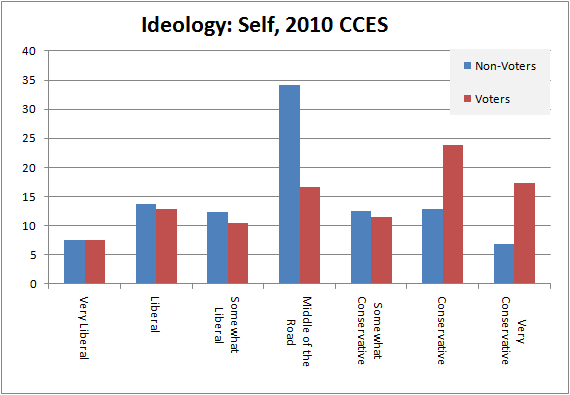
The Cooperative Congressional Election Study (CCES) is a new, very large sample survey that has been a real boon to voting behavior research. In 2010 the sample was over 55,000 whereas the old stand-by (American National Election Study) has about 1200. Briefly setting aside the valid question about whether people report voter turnout honestly on surveys – hint: they don't – here is a breakdown of self-reported ideology among voters and non-voters in the 2010 CCES sample. Click any graph to embiggen:

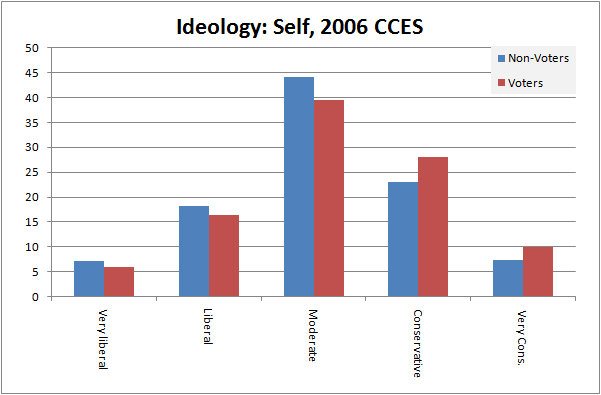
It is hardly surprising that a much larger percentage of non-voters consider themselves "middle of the road", as apathy toward participation is often a by-product of apathy toward politics in general. But note how a considerably larger portion of voters consider themselves "conservative" or "very conservative" – more than double the share of non-voters in each category. Compare that to 2006 – when the ideology question had only five categories instead of seven, but you get the picture:

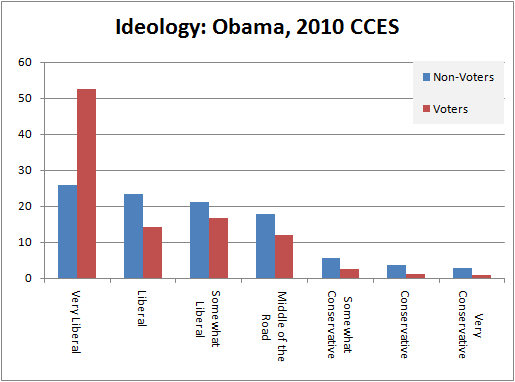
In the last midterm the ideological distribution of voters and non-voters is quite similar, with voters only slightly more conservative than non-voters. Even more interesting, here is the ideological placement of Barack Obama among voters and non-voters. In other words, survey participants are also asked to identify how they would describe the ideology of major political figures like the President, their reps in Congress, and so on:

Wow. I checked these number about five times because they are so lopsided.

online pharmacy orlistat no prescription

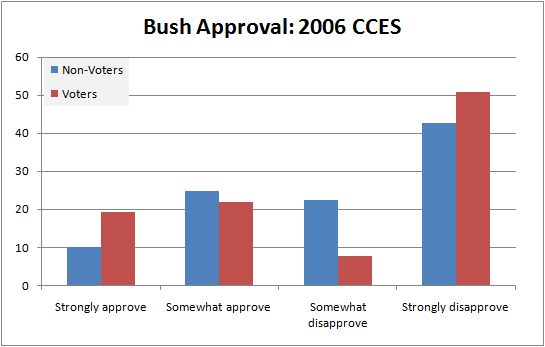
Of people who reported voting in 2010, more than half described Obama as "very liberal" whereas barely 25% of non-voters described him that way. The question is subjective, of course, but that's the point. The people who voted in 2010 appear to be disproportionately drawn from the ranks of people who think Barack "The Eisenhower Republican" Obama is the commie-libro-marxisocialist child of Fidel Castro and ACORN. Unfortunately the same question is not available from 2006 re: George W. Bush. They did ask a generic presidential approval rating question, though:

Again we see a roughly similar distribution – voters exceeded non-voters at the extreme points, i.e. they were more likely than non-voters to either really like or really dislike Bush. What we don't see is the heavily skewed distribution we see in the 2010 Obama Ideology question (although it bears re-emphasizing the differences in the two questions).

online pharmacy synthroid no prescription

This small slice of the CCES data from 2010 supports the hypothesis that voters and non-voters were ideologically dissimilar and had very different perceptions of the incumbent President and Congress.
buy metformin online noprescriptionrxbuyonline.com no prescription

It suggests that finding a way to recreate the enthusiasm for participation that Democratic-minded people showed in 2008 – or even 2006, when voters and non-voters were essentially even – is a necessary component of Obama and his party avoiding disaster in 2012. Something tells me that slogans and slick marketing won't be enough this time.